How ADAS Lane Assist Works
A camera behind your mirror that only looks for bright stripes, a radar that times echoes off the car ahead, and a steering motor that leans on the wheel with about the force of a bag of sugar, so your hands always win.
Step 01 of 08
A car that keeps its own lane
A car holding the middle of its lane at a steady cruise. Nothing on the outside gives the system away. Two clues hide in plain sight: a small black box behind the rear-view mirror, and the badge on the grille.
Step 02 of 08
Four parts, and one was already there
Ghost the body and lane assist comes down to four parts. A camera behind the mirror watches the road. A radar behind the badge watches the traffic ahead. A controller under the dash reads both. Its only way to steer is the electric power-steering motor on the column, the same motor that makes the wheel light when you park.
Step 03 of 08
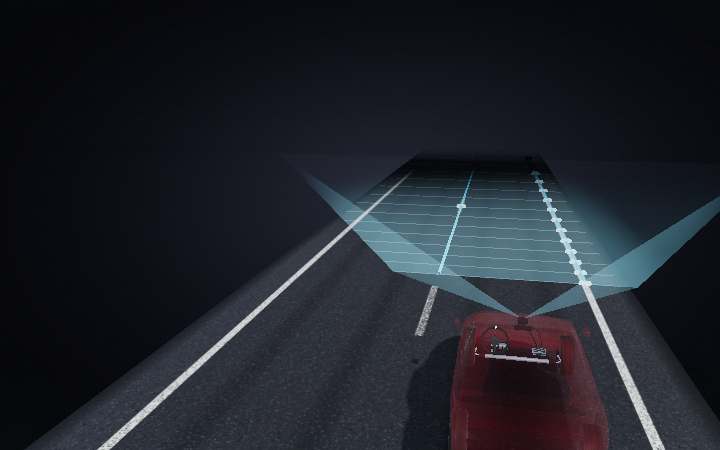
It looks for stripes, not roads
The camera has no idea what a road is. It scans its picture row by row, near to far, for the places where dark asphalt turns into bright paint, and marks each edge it finds. Where a dash ends there is nothing to mark. Then it fits one smooth line through the points on each side of your lane, bridging the gaps.
Step 04 of 08
Two numbers decide everything
From those two fitted lines the car works out two numbers: how far you sit from the middle of the lane, and which way you are pointing. Extend your heading forward and it meets a line at the amber ring. When that crossing comes up too soon and your indicator is off, the lamp lights and the wheel buzzes. On a warning-only system, you do the steering back.
Step 05 of 08
A little extra torque on the column
Lane keep assist goes one step further. Instead of only warning you, the controller asks the power-steering motor for a little extra torque on top of its normal help. The motor spins a worm that turns a gear on the column, the steering wheel rotates a few degrees by itself, and the front wheels steer the car back toward the middle.
Step 06 of 08
Weaker than you, on purpose
That nudge is capped at about 3 Nm. On a 38 cm wheel it is roughly 1.6 kg of push at the rim, so one hand beats it. A torque sensor in the column measures how hard your hands are twisting. Push the other way harder than the motor and the assist gives way. Take your hands off for too long and it warns you, then switches itself off.
Step 07 of 08
The car ahead is the radar’s job
Behind the badge, a 77 GHz radar sends out a continuous chirp that rises in pitch. The echo comes back as a slightly older note: the difference in pitch gives the distance, and the Doppler shift gives the closing speed. Adaptive cruise uses them to hold a time gap rather than a fixed distance, so when the car ahead slows you ease off until the gap is back. The camera supplies what the radar cannot: that the echo is a car.
Step 08 of 08
Run it
Back together. A camera that only sees stripes, a radar that only hears echoes, and a motor that only leans, all checking in dozens of times a second. You can always overrule it, because it is built to lose that argument. It never drives. It only leans.