How an Air Fryer Works
A coil of hot wire, a fan running hard enough to strip the steam off your food, and a pot small enough that the air never slows down — the machine that browns chips without frying anything.
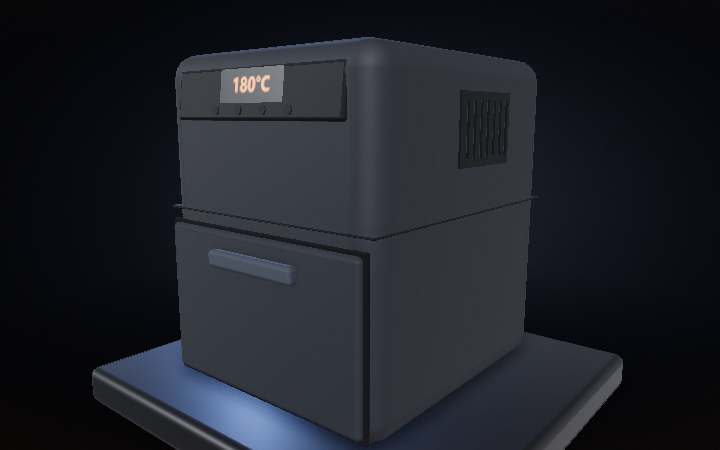
Step 01 of 08
No oil, no flame, no fryer
From the outside it is a matte box with a drawer and a lit panel. There is no oil to pour in, nothing visibly glows, and nothing touches the food. You drop in a handful of chips, push the drawer shut, and fifteen minutes later they come out with a crust on them. Everything responsible for that lives in the head above the drawer.
Step 02 of 08
Two parts and a lot of empty space
Ghost the shell and the entire cooking system turns out to be a coil of hot wire and a fan, mounted in the roof above a perforated basket. Below them sits a pot holding about five litres — a tenth of the air inside a full-size oven. That smallness is doing more work than it looks.
Step 03 of 08
1,500 watts of hot wire
The heat itself is unremarkable. A nichrome wire inside a steel sheath is bent into a flat spiral under the roof, turning about 1,500 watts of electricity into heat — the same trick a toaster uses. A thermostat probe a few centimetres away cuts it in and out to hold the temperature you dialled in. Left alone, this coil would scorch the top of the food and leave everything under it raw.
Step 04 of 08
The fan is the actual invention
Directly above the coil sits an axial fan turning at 1,200 to 2,000 rpm, which is fast for a kitchen appliance. It drives air down through the element and onto the food at roughly 5 metres a second. A countertop convection oven manages about 0.9. Nothing else in this machine is unusual — that one number is the entire product.
Step 05 of 08
The same air, over and over
There is nowhere for that air to escape to. It is pushed down through the coil onto the food, out through the holes in the basket floor, across a star-shaped ridge moulded into the base that throws it back outwards, up the narrow gap between basket and pot, and in through slots in the roof to the fan again. The perforated floor is not a tray with holes in it. It is a duct.
Step 06 of 08
What fast air actually does
Zoom in on one chip. Hot food is always wrapped in a thin skin of its own steam — moisture boiling off the surface and hanging there, insulating it and keeping it wet. Still air lets that skin sit. Air at five metres a second shears it off, and the surface underneath finally gets to dry. Crisping is a drying problem before it is a heating problem.
Step 07 of 08
And then it browns — but it does not fry
Once the dried surface climbs past about 140 °C, its sugars and amino acids start rearranging into hundreds of new compounds: the Maillard reaction, the same one behind bread crust and a seared steak. That browning is real. The frying is not — hot oil carries heat into food roughly ten times harder than moving air ever can. This is a very small, very fast convection oven with a much better name.
Step 08 of 08
A coil, a fan, and a box too small to slow down
And that is the whole machine. Fifteen hundred watts of wire, a fan running hard, and a pot small enough that the air it heats never gets a chance to lose its speed before it hits the food again.