How an Air Purifier Works
Air is pulled 360° through a pre-filter, a pleated HEPA H13 layer catching 99.97% of particles down to 0.3 micron, and an activated carbon layer for odors — then a centrifugal fan pushes it back out, paced automatically by a laser particle sensor.
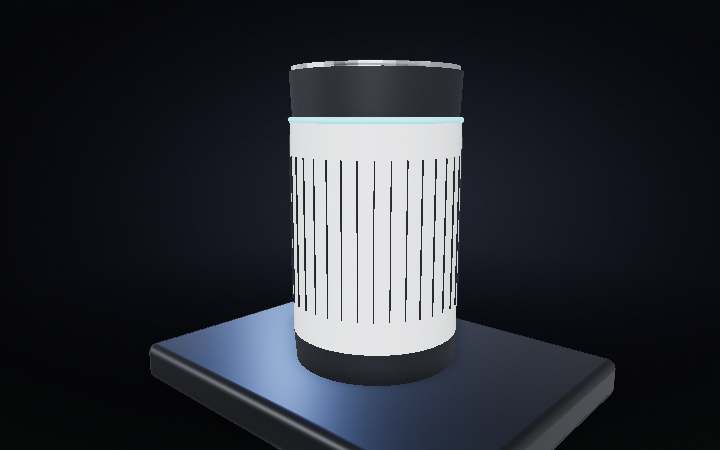
Step 01 of 07
1 · A sealed tower
From the outside, an air purifier is just a quiet cylinder: a ring of intake slots running all the way around, a grille on top, and a status ring that glows a color for the air quality it senses. Every stage of the actual filtering happens hidden inside.
Step 02 of 07
2 · Behind the wall
Lift the side wall away and it is really just one cartridge and one fan: a cylinder of filter media wrapped around a hollow core, with a small blower sitting above it to pull air up and out.
Step 03 of 07
3 · Pre-filter and HEPA strip the big stuff
Air is pulled in radially from all 360° around the tower. A fine mesh sock catches hair, fibers and large dust first — cheap insurance that protects the real work happening just behind it. That layer is a pleated HEPA H13 filter, folded like an accordion to pack far more surface area into the same cylinder: it captures 99.97% of particles down to 0.3 micron, the hardest size to trap, by physically intercepting and colliding with them in its dense fiber mesh.
Step 04 of 07
4 · Activated carbon pulls out the smell
HEPA media is superb at catching solid particles, but it does nothing for gases. Just behind it, a layer of activated carbon — a material so porous a single gram can have the surface area of a tennis court — adsorbs odor and VOC molecules straight out of the air, leaving them stuck to its surface instead of drifting into the room.
Step 05 of 07
5 · The blower pulls it all through
None of this happens on its own — a centrifugal blower above the cartridge is what drags air up through every one of those layers, then flings it sideways and out through the top grille. It is the one part of the system that never stops moving.
Step 06 of 07
6 · A sensor drives the whole response
A laser particle sensor near the base constantly samples the incoming air, counting how much it scatters light to estimate PM2.5 pollution in real time. Auto mode uses that reading to speed the fan up when the air is dirty and let it idle quiet when it is clean — and the ring on top reports the same number back to you, in color: blue and green for clean air, climbing to yellow and red as it gets worse.
Step 07 of 07
7 · Five layers, one continuous pull
Mesh, HEPA, carbon, a blower, and a sensor watching all of it — sealed back up, it goes back to being a quiet cylinder in the corner of a room, quietly doing all of that on every breath of air that passes through.