How a Car Airbag Works
A controlled explosion that is already letting go by the time you hit it. A sensor decides in about 20 milliseconds, a pellet ring becomes gas, and vent holes turn the bag into a cushion.
Step 01 of 08
1 · A seam in the steering wheel
Nothing on this wheel looks like a safety device. There is a flat plastic cover in the hub with a seam down the middle, and that is all. Behind it, a bag is folded up. This is a test rig: a wall rushes at the bumper, and a headform stands in for the driver. Watch the clock above the wheel, because the whole crash is slowed down about fifty times.
Step 02 of 08
2 · A folded bag on a can of propellant
Cut the hub open and the cover turns out to be a lid. Under it, a nylon bag is folded into a steel dish, pleat on pleat. Behind the bag sits the inflator, a steel can the size of a hockey puck. Its two igniters, the squibs, are wired to the car with a yellow cable. That wire is the whole connection between a crash and the bag.
Step 03 of 08
3 · Twenty milliseconds to decide
The wall hits at 0 ms. A sensor in the crumple zone feels the sudden deceleration and sends it down the yellow cable. Meanwhile the control unit has its own accelerometer: a silicon comb whose middle part lags behind the chip, squeezing the gaps in its fingers and changing its capacitance. The unit adds up the slowdown until it crosses a threshold. That takes about 20 ms, and it is the moment it fires.
Step 04 of 08
4 · A pellet ring turns into gas
The fire signal heats a hair-thin wire in the squib until it lights the first chamber of the inflator. A ring of small propellant pellets burns outward from the igniter, and in a few milliseconds the solid turns into a large volume of hot gas. In the classic design that gas was nitrogen from sodium azide. Most inflators now burn a non-azide fuel such as guanidine nitrate. The gas squeezes through a metal filter to cool it, and out through the ports.
Step 05 of 08
5 · Through the seam
The gas pushes the folded bag into the cover from behind, and the cover splits along its seam into two flaps. The bag unfolds as it fills, at roughly 300 km/h at the front of the gas. About 40 ms after the wall first touches the bumper, it is full, and the headform has not moved yet.
Step 06 of 08
6 · Landing on a leak
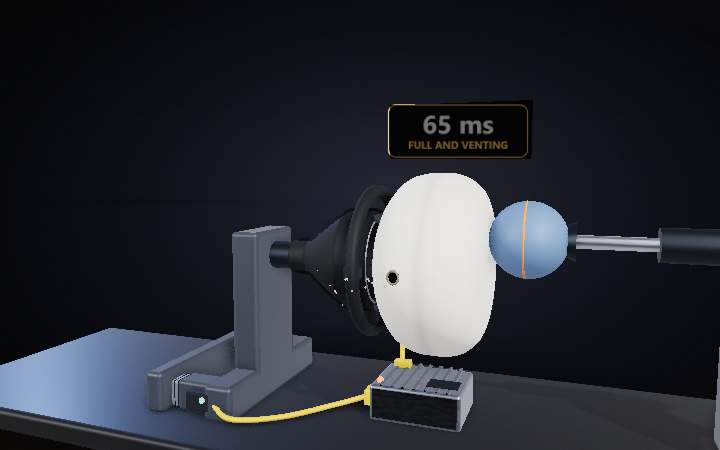
Two small holes in the back of the bag let the gas out from the moment it fills. So when the headform arrives, around 60 ms, the bag is already going soft. It gives under the load instead of throwing the head back, and the head slows over a longer time. That longer stop is what spares the driver. The bag is not a balloon, it is a brake.
Step 07 of 08
7 · Two stages, two sizes of crash
Most modern inflators have two propellant chambers, each with its own squib. On a mild crash only the first one burns, so the bag fills more gently. On a severe crash the control unit fires the second chamber a few milliseconds later and the bag fills harder. Same module, same wheel. The unit decides how much explosion the crash deserves.
Step 08 of 08
8 · Over in a tenth of a second
Put it all back together. A wall, a bumper, a wire and a can of powder: decide in about 20 ms, full in about 40, loaded by 60, and already letting go. It can only do this once, so everything has to happen in the right order, and fast.