Atomic Structure
Six protons, six neutrons and six electrons — and almost nothing else. The nucleus holds all the mass in a twenty-five-thousandth of the width, and the electrons are not orbiting it so much as smeared around it.
Step 01 of 09
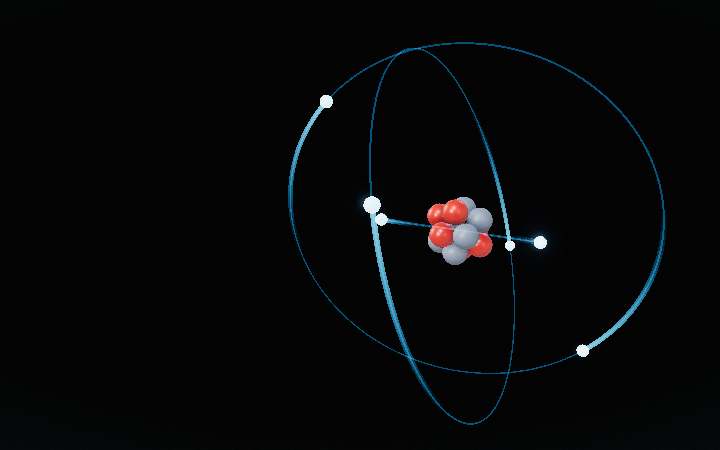
1 · A carbon atom, running
Every solid thing you have ever touched is built out of these. This one is carbon: twelve particles clenched together in the middle, six more sweeping around them. It is not a ball of anything. It is a tiny, absurdly dense knot with a great deal of nothing around it — and the nothing is what gives matter its size.
Step 02 of 09
2 · The knot in the middle
Fly into the centre and the atom stops being empty. Twelve particles are pressed together here, each about a millionth of a billionth of a metre across, every one touching its neighbours. Nothing in ordinary life is packed like this — a teaspoon of it would weigh around a billion tonnes. Holding it together is a force with almost no reach: past the particle next door, it simply stops.
Step 03 of 09
3 · Six protons is the entire definition of carbon
The red ones carry positive charge, and there are exactly six. That count is not a property of carbon — it is carbon. Five and this would be boron, seven and it would be nitrogen; nothing else about the atom gets a vote. Which leaves an obvious problem: six like charges crammed this close should tear the thing apart. Watch them try. At this range the strong force is over a hundred times stronger, and it hauls them straight back.
Step 04 of 09
4 · Neutrons bring mass and no argument
The grey ones are near-copies of the protons — a hair heavier, built from the same kind of stuff — except they carry no charge whatsoever. That makes them ideal packing material: they add to the strong pull that binds the nucleus while contributing nothing to the electrical push trying to burst it. Change how many there are and it is still carbon, just a different weight of it. Six is the carbon-12 in your bones; eight is the carbon-14 that dates a bone once you are done with it.
Step 05 of 09
5 · Six electrons, in two layers
Back out, and the rest of the atom is electrons — held by nothing but electrical attraction, six negatives answering six positives, so the whole thing comes out neutral. They cannot sit wherever they like. The first layer takes two and closes; the next has room for eight, and carbon only brings four. That half-empty outer layer is why carbon grabs four things at once, and why it, rather than any other element, ended up building you.
Step 06 of 09
6 · The rings are a lie
An electron does not run a lap. It has no path at all — only a probability of turning up somewhere — and this fog is the honest picture. Notice where it is densest: exactly where the ring was drawn, which is why the ring stayed a useful lie for a century. Between one measurement and the next there is no point on a track where the electron is. The count never changes, though. Six, smeared.
Step 07 of 09
7 · The fog has a shape
Those probabilities are not shapeless. Each electron occupies an orbital — a standing-wave pattern as fixed as the shapes a drum skin is allowed to vibrate in. Two of carbon's outer electrons fill the round one. The other two take a dumbbell each and, by a rule about spin, spread out instead of pairing up, which leaves the third dumbbell empty. Those two half-filled lobes are the hands carbon reaches out with.
Step 08 of 09
8 · Almost all of it is nothing
Here is the part nobody can really picture. That nucleus has been drawn about a thousand times too big this whole time. Shrink it toward the truth and it vanishes: the real one is a twenty-five-thousandth of the atom's width, and even the speck left here is far too large. Put a marble on the centre spot of a stadium and the electrons reach the back row — and the marble is 99.97% of the mass.
Step 09 of 09
9 · Neutral, empty, and somehow solid
Six positive, six negative, nothing left over — which is why an atom does not fling you across the room. And yet your hand will not go through a table, though both are very nearly empty. Nothing touches. What stops you is the outer electrons of one shoving the outer electrons of the other, plus a quantum rule that forbids two of them from settling into the same state. Solidity is a negotiation between clouds.