How a Ballpoint Pen Works
A bistable rotating cam, a tungsten-carbide ball smaller than a grain of rice, and a film of ink thinner than a hair — how one click locks a pen open, and one roll of a ball writes a line.
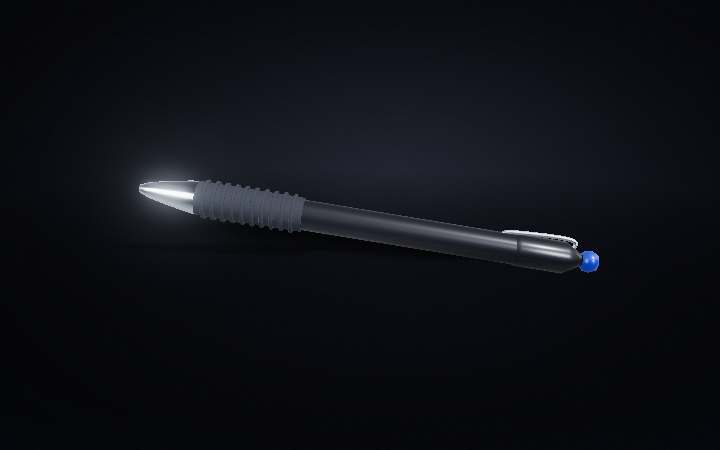
Step 01 of 07
A click, and it is ready
Every ballpoint pen is really three machines wearing one plastic shell: a bistable mechanical latch, a gravity-and-capillary ink pump, and a tiny rolling bearing at the tip. Watch the point through the little hole in the cone — one click and it snaps out, ready to write; click again and it vanishes back inside, safely capped, no lid to lose.
Step 02 of 07
Three machines, one shell
Strip the barrel away and the whole system is laid bare: a star-shaped cam at the top, a coil spring beneath it, and a long transparent tube of ink running almost the entire length of the pen down to the ball. Nothing here is complicated — every part is doing exactly one simple mechanical job, in sequence, every time you click.
Step 03 of 07
A latch with two stable states
Press the button and a plunger shoves the star-shaped cam down, clear of eight fixed teeth — the cam is free to rotate 45 degrees before the teeth stop it again. Release, and a spring pushes it back up, rotating another 45 degrees into whichever slot is now underneath: one slot holds the refill locked out and writing, the other holds it locked safely inside. Two clicks, 90 degrees each, and the whole refill has quietly rotated 180 degrees in the process — which is no accident: it evens out wear on the tip so it never scratches on one side only.
Step 04 of 07
A reservoir with no pump
There is no pump anywhere in a ballpoint pen — the ink simply sits in a sealed tube, thick and honey-slow, waiting at the top of a narrow capillary gap around the ball. Gravity and surface tension are enough to keep that gap topped up on their own; the ink is deliberately viscous so it clings to the ball instead of flooding out and blotting the page the moment you uncap it.
Step 05 of 07
A ball bearing that writes
The point itself is a tiny sphere of tungsten carbide, one of the hardest materials made, sitting loose in a socket barely bigger than it is. It is not driven by anything — dragging it across paper is what spins it, and every fraction of a turn carries a wafer-thin film of ink out of the reservoir and presses it onto the fibres. No moving parts, no batteries: friction alone runs the whole exchange.
Step 06 of 07
Small details, deliberately
The soft TPE rubber grip sits exactly where a hand naturally lands, moulded slightly wider than the barrel so the fingers settle without pinching. Its shallow ribs are there purely for friction, not looks — a few tenths of a millimetre of texture that stop a sweaty hand from sliding on an otherwise glassy plastic body.
Step 07 of 07
Run it
Click it open, write until the page fills, click it shut — a latch, a reservoir, and a rolling ball, repeated a few thousand times before the ink ever runs dry. Nothing electronic, nothing that needs charging: just geometry and viscosity, doing the same trick since 1945.