What Is a Black Hole?
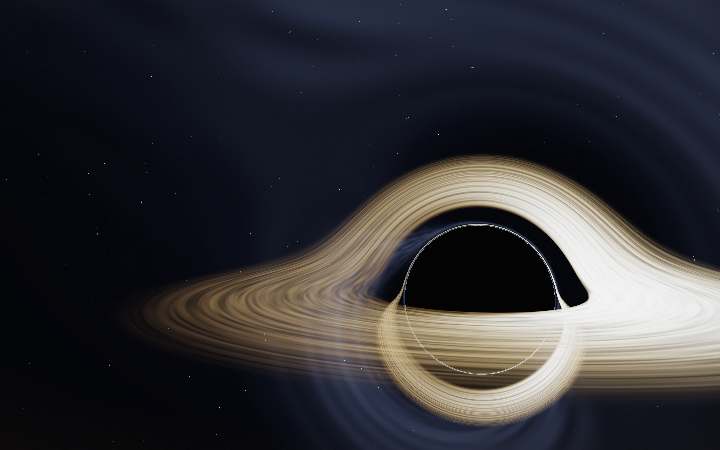
The dark circle is not the hole — it is 2.6 times wider than the hole, because the hole bends the paths of the light behind it. Everything you can see of a black hole is the last thing that got away.
Step 01 of 09
1 · A picture of the thing you cannot see
A black hole emits nothing. Everything in this image is light from somewhere else — gas orbiting outside it, stars far behind it — arriving by paths that gravity bent on the way to you. The disk appears to arc over the top because you are seeing its far side, lifted into view over a hole that should be hiding it. Nothing here is small: scaled to the black hole at the centre of our own galaxy, the glowing ring in front of you would be about as wide as Earth's orbit around the Sun.
Step 02 of 09
2 · There is nothing there
The event horizon is not a surface. Nothing is built there, nothing is stored there — it is simply the distance at which the escape speed reaches the speed of light, so anything closer is already committed. Its size depends on mass alone: a 10-solar-mass hole is 60 km across, the one at the centre of our galaxy is 25 million km across — about 18 Suns side by side — and it would still fit comfortably inside Mercury's orbit.
Step 03 of 09
3 · The dark circle is not the hole
The hole is the small white ring. The darkness around it is 2.6 times wider, because rays that would have missed the hole are still bent hard enough to fall in — so a whole region of sky goes dark behind it. That silhouette has a radius of exactly √27 GM/c² — 2.6 Rs, so 5.2 Rs across — for every non-spinning black hole in the universe. When the Event Horizon Telescope measured M87*, that ratio predicted 39.5 microarcseconds; they photographed 42.
Step 04 of 09
4 · Where light can go into orbit
At 1.5 horizon-radii there is a distance where light circles the hole. Watch the three rays: the outer one is bent and carries on, the middle one whips more than three-quarters of the way around before escaping in a completely new direction, and the inner one never comes back. The bright rim of the shadow is made of rays that took that middle path — light that looped the hole and then came to you.
Step 05 of 09
5 · The last orbit that holds
Further out, gravity behaves the way it does around a star: circle at the right speed and you stay. Closer in, that stops being true. At three horizon-radii you reach the innermost stable circular orbit — moving at exactly half the speed of light — and inside it no circular orbit survives at all. That is why the disk has such a sharp inner edge. It has not been swept clean; gas simply cannot hold an orbit any closer, so whatever crosses that line is already falling.
Step 06 of 09
6 · Why the gas glows
Nothing is burning. Gas closer in has to orbit faster, so neighbouring rings grind past each other, and friction plus tangled magnetic fields turn that shear into heat — the inner disk of a stellar-mass hole reaches ten million degrees and radiates X-rays. As a way of turning matter into light it is unmatched: accretion releases 10 to 40 percent of an object's rest mass, against 0.7 percent for the nuclear fusion running the Sun.
Step 07 of 09
7 · One side is brighter — and it is not hotter
The gas on one side is coming at you at a fair fraction of light speed, and that alone concentrates and blue-shifts its light; the other side is receding and dims. Observed brightness scales as the Doppler factor to the fourth power, so a modest speed difference becomes a dramatic one. The relativistic effects switch off and back on through this loop — the disk itself never changes.
Step 08 of 09
8 · Falling in takes forever to watch
Send a probe down and you will never see it arrive. Clocks run slower deeper in the field — one riding the innermost stable orbit ticks at 71% of yours — and as the probe approaches the horizon its signals arrive further and further apart, each one stretched redder than the last, until it fades out still hanging above the edge. From the probe's own point of view, nothing unusual happens and it crosses in finite time.
Step 09 of 09
9 · Mass, and nothing else
Every feature here came from one number. Set the mass and the horizon, the photon sphere, the shadow and the last stable orbit all follow — a black hole a billion times heavier looks exactly like this one, just bigger. And it does not reach out: swap the Sun for a black hole of the same mass and Earth would keep to its orbit, on time, in the dark.