How Car Suspension Works
A spring that turns a pothole into a slow squeeze, a tube of oil that refuses to give the energy back, and a 22 mm bar that only wakes up when the two sides of the car disagree.
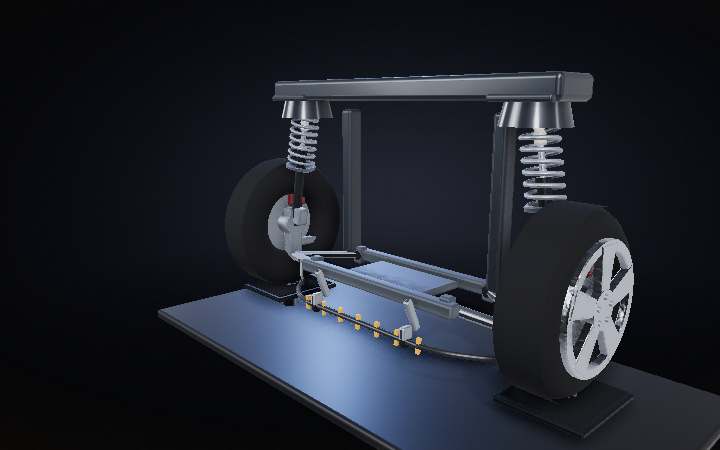
How does car suspension work?
Car suspension works in two stages: a spring absorbs a bump by turning a sharp jolt into a slow squeeze, then a shock absorber bleeds that stored energy away as heat by forcing oil through small holes — because a spring alone would just bounce forever. A third part, the anti-roll bar, only engages when the two sides of the car disagree, keeping the body flat in corners.
Step 01 of 07
The car is barely touching the road
Four patches of rubber, each about the size of your hand, are everything that connects a tonne and a half of car to the ground — and the ground is never flat. Below the springs, the wheels are being thrown up and down by every ridge and seam they cross. Above them, the body is trying to keep travelling in a straight, level line. Watch the road move under each tire, then watch how little of it arrives at the body.
Step 02 of 07
One arm, one strut, no upper wishbone
The wheel is held by surprisingly little. A single lower control arm swings on two rubber bushings and catches the bottom of the steering knuckle at one ball joint. The top is held by the strut itself — a tube that is both spring and shock absorber, bolted rigidly to the knuckle and hinged into the body at a single mount up in the turret. That is the entire MacPherson layout, and skipping the upper arm is why it is under almost every front wheel on the road: the space it saves is where the engine goes.
Step 03 of 07
The spring buys you distance
A spring does not absorb a bump — it converts one. A sharp, violent shove at the tire becomes a slow squeeze spread across 80 mm of travel instead of arriving all at once. This coil takes about 30 newtons to compress each millimetre, and it is already squatting some 110 mm under the weight of its corner of the car. Because the wheel sits further out along the arm than the spring does, the car feels a slightly softer rate than the coil’s own — nearer 24 newtons a millimetre. Hung on four of those, the body bobs a little under one and a half times a second, about 1.4 hertz, close to the rhythm of an unhurried walking stride. That is a large part of why a car feels right rather than nauseating.
Step 04 of 07
A spring on its own is a pogo stick
Here is the trouble with springs: they give everything back. Energy pushed into the coil comes straight out again, so a car riding on springs alone never settles after a bump — it keeps trading height for speed, bounce after bounce. And every time the body rises, the tire goes light. A light tire cannot steer and cannot brake. Something has to eat that energy on the way through, and it cannot be the spring.
Step 05 of 07
Nothing in there but oil and small holes
Unbolt the spring, section the strut, and this is the whole shock absorber: a cylinder of oil with a valved piston in it. Every hole in that piston is a doorway the oil must squeeze through, and forcing oil through a small hole takes a force that climbs with SPEED, not distance. Ease over a dip and the damper barely resists; slam a sharp ridge and the same holes push back with 800 to 1500 newtons. Rebound is deliberately the harder direction — two to three times the compression force — because on the way back up the spring is no longer helping. All of that force is your bounce leaving as warm oil, which is why a hard-worked damper is genuinely too hot to hold.
Step 06 of 07
The bar that only wakes up when the two sides disagree
A 22 mm bar of spring steel runs across the car in two bushings, with a short link down to each control arm. Drive over something that lifts both wheels together and the bar simply rotates in its bushings — it contributes nothing. Lean the car into a corner, though, where one side compresses while the other extends, and the bar has no choice but to TWIST. Now it fights: hauling the loaded side up, pressing the light side down, holding the body flat without stiffening the ride over ordinary bumps. Its strength runs with the fourth power of its diameter, so going from 22 mm to 26 mm makes it nearly twice as stiff.
Step 07 of 07
Run it
Wheel back on, road roughened, everything working at once: the springs carrying the weight, the dampers turning what is left of each bump into heat, the arms and ball joints holding the wheels where the steering put them, and the bar refusing to let the body lean. This happens several times a second, for a decade, in the dark, under a car nobody ever looks beneath — and the entire point of it is that you feel almost none of it.
The parts
- MacPherson strut — A single tube that combines the spring and shock absorber into one unit, bolted rigidly to the steering knuckle and hinged into the body at one mount. Skipping the upper control arm this design needs is why it sits under almost every front wheel on the road — the space it frees up is where the engine goes.
- Coil spring — The part that actually absorbs a bump — not by resisting it, but by converting a sharp shove into a slow squeeze spread across tens of millimetres of travel.
- Shock absorber (damper) — An oil-filled cylinder with a valved piston inside it. Every hole in that piston is a doorway the oil must squeeze through, and that resistance is what stops the spring from bouncing forever.
- Lower control arm — Swings on two rubber bushings and catches the bottom of the steering knuckle at a ball joint — the main link holding the wheel in position relative to the body.
- Ball joint — The pivot connecting the control arm to the knuckle. It has to let the wheel steer and travel up and down at the same time, which is exactly why it wears.
- Anti-roll bar (sway bar) — A bar running across the car that only twists when the two sides move differently — over an ordinary bump that lifts both wheels together, it just rotates freely in its bushings and does nothing.
- Bump stop — A firm rubber or polyurethane cushion inside the strut that only makes contact right at the end of travel, softening a full-compression hit instead of leaving the suspension to crash metal-on-metal into its own limit.
Numbers that matter
| Figure | Value | Note |
|---|---|---|
| Coil spring rate | ~30 N/mm | ~24 N/mm as felt at the wheel, since the wheel sits further out along the arm than the spring |
| Spring travel | ~80 mm | the range a single bump gets spread across instead of arriving all at once |
| Body bounce frequency | ~1.4 Hz | close to the rhythm of an unhurried walking stride |
| Damper compression force | 800–1,500 N | climbs with the SPEED of the hit, not how far the suspension travels |
| Damper rebound force | 2–3× compression | rebound is deliberately harder — the spring isn’t helping on the way back up |
| Anti-roll bar diameter | 22 mm | stiffness scales with the 4th power of diameter — 22→26 mm nearly doubles it |
| Unsprung mass (per corner) | ~40 kg | wheel, hub, brake and arm — everything the spring isn’t supporting against inertia |
Common questions
How can you tell if your shocks are worn out?
Push down hard on one corner of the car and let go. A healthy shock lets the body bounce back up once, maybe settle with a half-bounce, then hold steady. If it keeps bouncing, the shock is too weak to control the spring anymore. Test all four corners — wear is rarely even across the car.
What does "unsprung mass" actually mean, and why does it matter?
It’s everything the spring doesn’t get to support against inertia between bumps — the wheel, hub, brake and control arm, roughly 40 kg per corner. The lighter that mass, the faster the wheel can follow the road surface instead of skipping over it, which is why keeping it down matters as much to grip as it does to ride comfort.
Why does a stiffer anti-roll bar make cornering feel flatter?
Because the bar resists twisting harder when the two sides disagree, which is exactly what happens as the body leans into a corner. The tradeoff is real, though: push a bar too stiff and it can unload the inside wheel enough in hard cornering to actually cost grip at that end of the car, which is why front/rear roll stiffness is tuned as a pair, not maximized independently.
Why does the damper respond differently to a slow dip than a sharp bump?
Because forcing oil through a small hole takes a force that climbs with speed, not distance. Ease over a gentle dip and the oil has time to get through — barely any resistance. Hit a sharp ridge and the same holes have to pass the same oil much faster, so the force spikes hard in response.
Why is a worn ball joint dangerous rather than just noisy?
Because it’s a structural connection, not just a wear item. A ball joint that fails completely lets the control arm disconnect from the steering knuckle entirely — the wheel can drop and collapse into the wheel well while the car is moving, which is why any looseness or clicking there is worth acting on immediately rather than waiting.
What goes wrong
What does a clunk from the suspension usually mean?
It depends on where and when. A metallic clunk over bumps, especially while turning, usually points to a worn anti-roll-bar link — loosened joints letting the link rattle. A duller thud or creak points to worn control-arm bushings. A sharp metallic click or pop while steering, or a feeling of looseness in the front end, points to a ball joint.
What happens if a ball joint fails completely while driving?
The control arm disconnects from the steering knuckle, and that corner of the car loses its structural link to the wheel — it can drop and collapse into the wheel well. It’s one of the few suspension failures that’s a genuine safety event rather than just a ride-quality complaint.
How do you know a shock absorber has actually failed, versus just feeling old?
Beyond the bounce test: watch for brake dive (the nose dropping hard under braking), acceleration squat, or noticeably more body roll in corners than the car used to have — all signs the shock isn’t controlling weight transfer anymore. Visible oil leaking down the shock body, or a metal-on-metal clunk when it bottoms out on a bump, both mean it has already failed.