How a Coal Power Plant Works
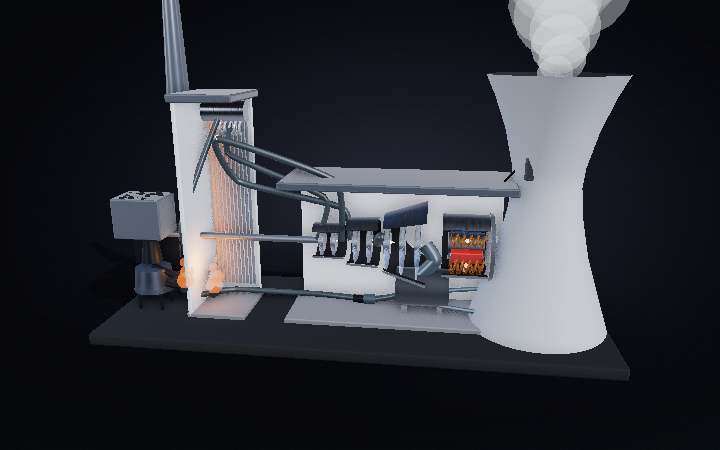
Pulverized coal burns in a boiler to raise steam at over 500°C, which blasts through a multi-stage turbine and generator before condensing back to water in a closed loop, cooled by the plant's iconic tower.
Step 01 of 08
The anatomy
A coal plant is a heat engine: burn coal to boil water into steam, let that steam spin a turbine, and use the turbine to spin a generator. Everything else — the boiler, the condenser, the cooling tower — exists to make that one conversion (heat to spin) as efficient as possible, and to get the water back so it can be boiled again.
Step 02 of 08
1 · Coal to heat
Coal is crushed to a fine powder in a pulverizer — about as fine as flour — so it burns almost instantly when blown into the furnace. That combustion is the plant's only energy input: chemical energy stored in the coal becomes heat, released fast enough to keep an enormous furnace running white-hot around the clock.
Step 03 of 08
2 · The boiler makes steam
The furnace's walls are lined with waterwall tubes — water flowing through them is boiled by the radiant heat and rises to a steam drum at the top. A superheater then drives that steam far past its boiling point, to roughly 540°C at 16-18 MPa, before it's allowed to leave for the turbine: hotter, higher-pressure steam carries more usable energy per kilogram.
Step 04 of 08
3 · Steam spins the turbine
The steam blasts through a high-pressure stage first, then is piped back to the boiler's reheater to be resuperheated before continuing through intermediate- and low-pressure stages — all three share one shaft. As pressure keeps dropping, the same mass of steam takes up far more volume, which is why the blades visibly lengthen toward the low-pressure end.
Step 05 of 08
4 · The generator induces current
The same shaft carries that spin straight into the generator, where a rotor of magnetic poles turns inside a ring of fixed stator windings. Each time a pole sweeps past a winding, the changing field induces a voltage in it — Faraday's law, the same electromagnetic induction a hydro plant or a transformer uses, just driven here by a steam turbine instead of falling water.
Step 06 of 08
5 · Closing the loop
Spent low-pressure steam leaves the turbine and is condensed straight back into water in the condenser — dropping its volume roughly a thousandfold, which is what pulls steam through the turbine so effectively. The heat that steam gives up is carried away by a SEPARATE circuit of cooling water to the plant's hyperboloid cooling tower, which releases it as a plume of ordinary water vapor, not smoke. A feed pump then returns the condensed water to the boiler, closing the primary loop.
Step 07 of 08
6 · Step-up & the grid
Current straight off the generator is still at a modest voltage — far too low to travel long distances without huge resistive losses. A step-up transformer raises it dramatically before it heads out on transmission lines, trading current for voltage so the wires can carry the same power at a fraction of the loss. From here it's substations and towers all the way to a wall socket.
Step 08 of 08
The plant runs
Coal, boiler, turbine, generator, condenser, cooling tower, transformer — one continuous energy chain, chemical to electrical, with the same water endlessly reused in between. Every coal plant on Earth is this same Rankine cycle at a different scale.