How a Cyclone Works
A hurricane is a heat engine that builds itself out of warm seawater. It burns about 6 x 10^14 watts of evaporated ocean — 200 times the electrical output of the United States — and turns roughly a tenth of it into wind.
Step 01 of 08
A machine that builds itself
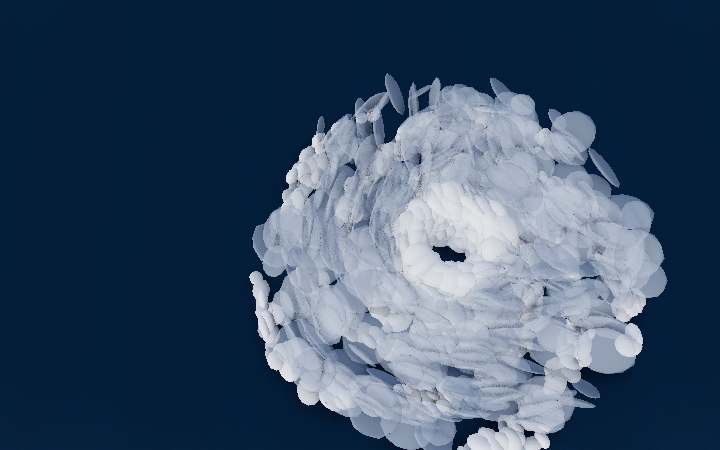
This is eight hundred kilometres of ocean air turning around a hole. There is no shell, no shaft and no fuel tank — only seawater, sunlight and the spin of the planet. And yet it runs like an engine: an intake along the sea, a hot stage in the wall of cloud, an exhaust spilling out of the top. Everything after this is that engine, taken apart.
Step 02 of 08
The fuel is warm water
A cyclone can only run over sea that is at least 26.5 °C, and warm about fifty metres down — any shallower and the storm churns up cold water and starves itself. That surface hands the air water vapour by the cubic kilometre. The heat is not in the air yet; it is hidden inside the vapour, and it stays hidden until the vapour climbs.
Step 03 of 08
Why it turns instead of filling
Air rushes toward the low pressure in the middle — but the planet is turning underneath it. In the northern hemisphere every moving parcel gets nudged to its right, so it never actually arrives. It swings past the centre, comes round, and settles into an orbit. The grey paths are where that air would have gone on a planet that stood still.
Step 04 of 08
Then it winds itself up
Air spiralling inward has to turn faster to keep the angular momentum it started with — a skater pulling her arms in, except eight hundred kilometres across. Faster wind means lower pressure at the centre; lower pressure pulls the air in harder; harder inflow spins faster still. Once that circle closes, the storm is feeding itself.
Step 05 of 08
The engine, cut open
Here is the whole cycle as one circuit. Wet air crawls in along the sea in a layer barely a kilometre deep, turns the corner at the eyewall and climbs fifteen kilometres. On the way up the vapour condenses and finally lets go of its heat — which is what drives the climb. At the top the air is wrung dry, spreads outward under the tropopause, and sinks back to the sea far away to be used again. A large storm runs that loop at roughly six hundred trillion watts.
Step 06 of 08
The eyewall does all the work
Every bit of that heat is released in one ring of thunderstorm, and that ring is where the wind is: a Category 5 begins at 252 km/h and it is measured here, nowhere else. Watch the wall lean outward as it rises. Air climbing the wall keeps the angular momentum it arrived with, and the surface that traces flares as it goes up — which is why, from the middle, it looks like a stadium.
Step 07 of 08
Inside the eye
The middle of the most violent storm on Earth is calm, dry and often sunny. Air sinking down the middle warms as it compresses, and warm air will not hold cloud — so it burns a clear well straight down to the water, ringed by the tallest thunderstorm on the planet. It is also the lowest sea-level pressure ever measured: 870 hPa, in Typhoon Tip in 1979, about fifteen per cent below a normal day.
Step 08 of 08
Then it reaches the coast
The engine only runs on warm water, so the storm begins dying the moment it crosses the shore: the fuel is simply gone, and rough ground drags at its base. But the low pressure and the wind have spent days piling a dome of seawater up under the eye, and that dome comes ashore with it. The surge, not the wind, is usually what does the killing.