How a Dishwasher Works
It never fills up. Two litres sit in the bottom, and a pump throws that same puddle at your plates for two hours through arms that spin with no motor.
Step 01 of 09
Two hours of nothing you can see
A dishwasher gives you one button and then goes quiet. Behind that stainless door there is no drum to watch and no window to look through — just a hum, a swishing noise that changes every few minutes, and eventually clean plates. What is actually happening in there is stranger than most people picture. It is not a bath. Your dishes never touch a pool of water at all.
Step 02 of 09
The door is a shelf, and half the machine
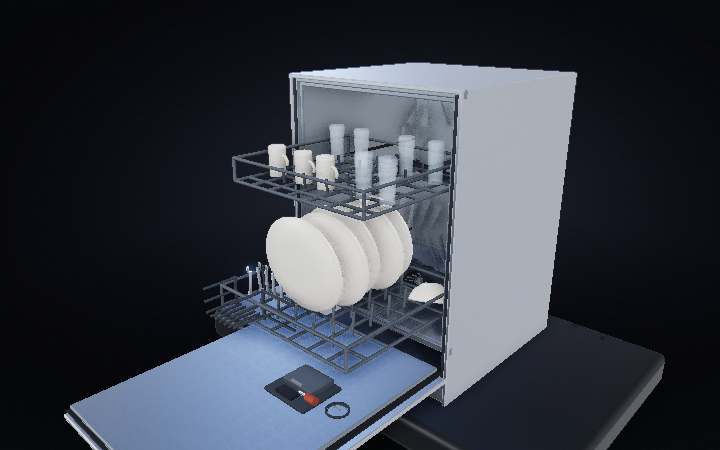
Pull the handle and the whole front falls forward on a hinge at floor level, held by two counterbalance springs so it stops flat instead of dropping. Two wire racks roll out over it on rails: plates stood on edge below, glasses and cups upside down above, cutlery in its own basket. Nothing here is decoration. Every dish is angled so that water thrown from underneath can reach its dirty face and then run straight back off it.
Step 03 of 09
The soap is on a timer, not a trigger
On the inside of the door sits a plastic cup with a sprung lid. You load the tablet, shut the flap, and it stays shut — through the fill, through the cold pre-rinse that washes the worst of the food away. Only when the machine is ready does a wax motor let the catch go — a pellet of wax with a small heater wrapped round it, which expands and shifts a plunger a couple of millimetres, just far enough to trip the release. The lid springs open and the tablet drops into hot water, not cold.
Step 04 of 09
It never fills up
Take the cabinet off and the surprise is what is missing. There is no tank and no bath. The inlet valve lets in about two litres — a puddle a couple of centimetres deep, sitting in a well in the floor called the sump — and then shuts. That is all the water in the machine at any moment. The dishes stand a foot above it and stay dry until something throws it at them.
Step 05 of 09
The pump doing all the washing
Underneath the tub, in about fifteen centimetres of space, sits a centrifugal pump: a disc of curved vanes spinning near 2800 rpm inside a snail-shaped housing. It sucks the sump dry through the filter and flings the water outward, and the housing turns that speed into pressure. On the way out the water passes a flow-through heater — a heated sleeve in the pipe itself — which lifts it to about 55 °C for a normal wash, or 70 °C when you ask for sanitise.
Step 06 of 09
The arms spin themselves
Water goes up a duct in the back wall to two spray arms, and here is the trick: neither arm has a motor. Look at the nozzles and they are not pointing straight up — each one is tipped sideways, so every jet leaves at an angle. Push water one way hard enough and it pushes the arm the other way, exactly like a lawn sprinkler, and the whole thing winds up to somewhere between 30 and 60 rpm on its own. That is why a blocked nozzle stops an arm dead: you have removed its engine.
Step 07 of 09
The same two litres, over and over
Everything the arms throw runs off the dishes, down the walls and back into the sump through a filter — a coarse strainer that catches the peas, a fine mesh that holds the crumbs. The pump picks it straight back up. That single puddle goes round hundreds of times in one wash. Only at the end does a second, smaller pump push it out through a hose that has to rise in a high loop above the tub, because without that climb the drain could siphon dirty water back in.
Step 08 of 09
Drying with no fan and no towel
The last rinse is the hottest, and it carries rinse aid — a surfactant that drops the water's surface tension so it cannot hold itself into beads. Instead it sheets off the glass in one film and takes almost nothing with it. Then the machine simply stops. The dishes are hotter than the stainless walls around them, so what moisture is left evaporates off the china and condenses on the cold steel, runs down, and drains away. The drying is done by the temperature difference alone.
Step 09 of 09
Eleven litres, start to finish
Shut the door and all of it disappears again: fill, heat, soap, wash, drain, rinse, drain, dry — four or five little fills of about two litres each, roughly eleven litres for the whole load. The same job at the sink, under a running tap, can take five times that and never gets near 55 °C, because your hands cannot. The machine is not being thorough by using more. It is being thorough by using the same water, again and again, very hard.