How an Earthquake Works
The ground under a fault is moving all the time — about 3.5 cm a year — but friction holds the fault shut, so the rock bends instead. An earthquake is that bend snapping back in seconds, and the waves it throws off.
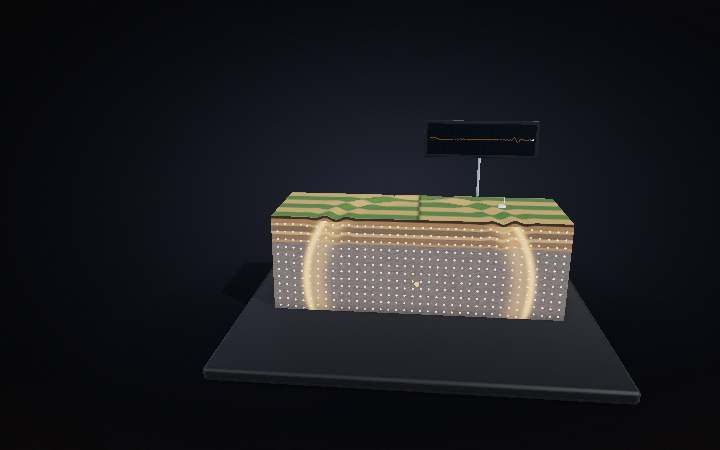
Step 01 of 06
Solid ground, until it isn’t
This block is a slice of the crust, 44 km across and 15 km deep, with farmland on top and a fault running down the middle. Watch the fence lines. They bend, slowly, and then everything jolts at once and they come back straight — just no longer lined up. That jolt is the earthquake.
Step 02 of 06
The ground never stops moving
One side of this fault is sliding past the other at about 3.5 cm a year — about as fast as your fingernails grow. But the fault itself is jammed shut by friction. So the rock can’t slip. It bends instead, like a ruler flexed in your hands, and the red is the strain piling up nearest the fault, year after year, for decades or centuries.
Step 03 of 06
Then friction loses
The break starts at one point on the fault, usually 5 to 15 km down: the hypocentre. The spot on the surface straight above it is the epicentre. From there the slip unzips across the fault at around 3 km a second, and as it passes, the bent rock on either side springs back straight. That spring-back is called elastic rebound, and it is where all of an earthquake’s energy comes from.
Step 04 of 06
Two waves, two kinds of shove
The released energy races out through solid rock as waves. First the P wave, at about 6 km a second: it pushes and pulls the rock along the direction it travels, like a pulse down a Slinky. Then the S wave, at about 3.5 km a second: it shakes the rock sideways, across the direction of travel, and harder. A seismometer records them as two separate arrivals, and the gap between them gives the distance — about 8 km for every second.
Step 05 of 06
The slow roll that does the damage
When those waves reach the surface, they set the ground itself rolling. Surface waves spread out from the epicentre more slowly than either P or S, so they arrive last — but they are the biggest and they last the longest. On the seismogram they’re the widest swing, and they are often what does the most damage to buildings.
Step 06 of 06
And then it starts again
Once the slip stops, the fault locks up again and the plates carry on at fingernail speed. The bending starts over, building toward the next one. How big that one is depends on how much fault breaks at once: each step up in magnitude releases about 32 times more energy, so a magnitude 7 releases about a thousand times the energy of a magnitude 5.