How an Electric Water Heater Works
A steel bottle in a foam coat, holding hot water stacked on cold with a sharp line between them — plus two 4,500-watt wires that are wired so they can never both be on.
Step 01 of 08
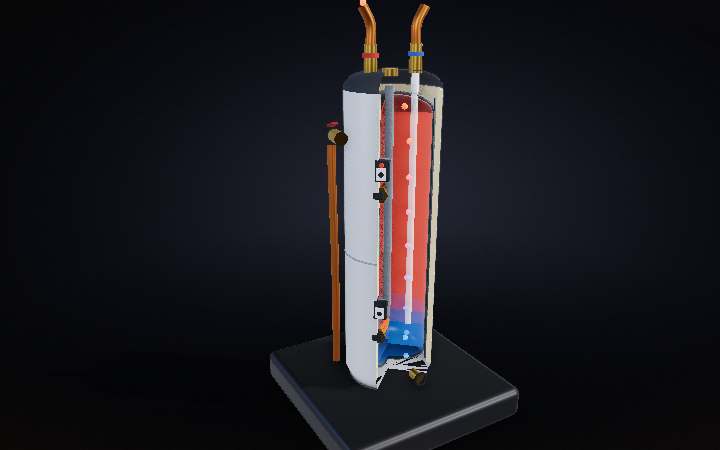
A barrel of hot water, waiting all day
Two pipes on top, a valve on the flank, two little panels screwed to the front. That is the whole of it from outside — no flame, no vent, no moving part you could point at. Everything that makes it work is sealed inside a steel bottle you are not meant to open, and it has been holding 150 litres at 60 °C since the last time anyone in the house wanted a shower.
Step 02 of 08
A steel bottle in a foam coat
Cut the jacket away and the wall turns out to be three layers. Painted sheet steel on the outside, holding nothing but its shape. Then 25 to 50 mm of rigid foam. Then the tank that actually does the work: welded steel with a layer of glass fused to the inside of it, because steel is strong but rusts and glass does not rust but cracks. Bonded together they can hold hot, oxygen-rich water for a decade.
Step 03 of 08
The cold water is sent to the floor
Both pipes come out of the top, which looks like a mistake: cold arriving a hand-width from where hot leaves. A plastic dip tube fixes it. It hangs off the cold inlet almost to the bottom of the tank, so incoming cold is dumped at the floor while hot is skimmed off the very top. Every drop that enters has to cross the whole tank before it can leave.
Step 04 of 08
The tank is layered, not mixed
Hot water is about 1.6 % lighter than cold at these temperatures. It is not much, but buoyancy does not need much: the hot floats, the cold sits under it, and the boundary between them stays thin — centimetres, not a gentle gradient. Draw a shower and that line climbs. Everything above it is still at full temperature, which is why the water stays perfect right up until the moment the line reaches the outlet and the shower goes cold in about ten seconds.
Step 05 of 08
Two elements, and they never run together
Each is a loop of resistance wire in a copper sheath, screwed straight through the tank wall so it sits in the water: 4,500 watts apiece. On a cold tank the upper one fires first, because heating the top third is the fastest route to one hot shower. Only once that top is up to temperature does power hand down to the lower element for the rest. The switch is built so both can never be live at once — the whole machine draws 4,500 watts, not 9,000, and refills with hot at about 80 litres an hour.
Step 06 of 08
The thermostat never touches the water
Both thermostats clip to the outside of the tank wall, behind those access panels, pressed flat against bare steel — they read the water through it. Inside each is a bimetal disc that bends as it warms and snaps its contacts open at the temperature you dialled in. Behind the upper one sits a second disc you cannot adjust: the energy cut-off, which trips near 85 °C and stays tripped until somebody pushes the red button.
Step 07 of 08
The rod that dies so the tank does not
The glass lining is never perfect — there are pinholes in it, and bare steel at the weld seams. So a magnesium rod hangs down inside every one of these tanks. Magnesium gives up electrons far more readily than steel, so in the water it corrodes and the exposed steel does not. It is meant to be eaten; when it is gone, the tank is next. Meanwhile the minerals that fall out of heated water settle on the floor beneath the lower element as a crust, and the rumbling you hear at night is water trapped under it flashing to steam.
Step 08 of 08
A bottle that spends its life defending a temperature
Cold in at the floor, hot off the top, a thin line between them that climbs when you draw and sinks when the elements catch up. No flame, no pump, nothing clever. Just a very well insulated tank, two wires, and a rod quietly corroding on your behalf.