How an Elevator Works
A car, a counterweight, and a grooved wheel that grips rather than winds — plus the wedge that catches you if every rope lets go.
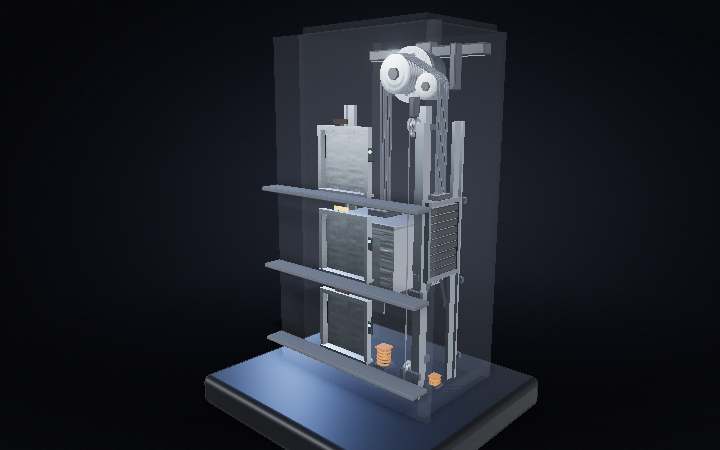
Step 01 of 08
The machine you use most and have never seen
From the outside an elevator is two steel doors, a button and a number that counts. You press, you wait, the doors part, you step across a gap into a small lit room. Nothing about the lobby tells you that the room is hanging from five ropes, that something almost exactly as heavy as you and the room is falling down a shaft while you rise, or that the motor doing it is bolted to a beam a few metres above your head.
Step 02 of 08
A car, a weight, and one loop of rope
Take the concrete away and the whole machine is visible at once. Five steel ropes run up from the roof of the car, over a grooved wheel at the top of the shaft, and down the other side to a stack of steel slabs in a frame. The two ends are tied together by rope that cannot stretch, so they can only ever move in opposite directions: the car goes up exactly as far as the counterweight comes down. Nothing here is winding anything in.
Step 03 of 08
The sheave grips — it never winds
The wheel at the top is a traction sheave, and the ropes only pass over it. Five V-shaped grooves pinch each rope as it wraps across the top, and the friction in those grooves is the entire connection between the motor and you. Behind it sits a gearless permanent-magnet motor — a wide, slow, high-torque disc turning the sheave directly, no gearbox at all — and a brake disc bigger than the sheave itself, held clamped by springs. Power the brake to release it; cut the power and it grips.
Step 04 of 08
The counterweight does most of the lifting
That stack of steel slabs weighs about what the empty car weighs, plus roughly 45% of the load the car is rated for. So a half-full car is very nearly balanced against it, and the motor is only ever asked to move the difference — a few hundred kilos, not the two tonnes actually hanging there. It also works both ways: going down, the counterweight is the heavy end, and the motor spends the trip holding it back rather than hauling it up.
Step 05 of 08
Two rails are the only thing holding it straight
A car on ropes alone would swing like a pendulum. Instead it runs between two machined steel rails bolted up the full height of the shaft, gripped top and bottom by roller guides that ride the rail faces and take every sideways push — people walking to one side, wind pressure, the doors slamming. The counterweight has its own pair. Trailing underneath the car is the travelling cable: the power, the buttons, the phone and the video, hanging in a loop that unfolds as the car descends.
Step 06 of 08
What catches you is speed, not the rope
Watch the car leave the top floor too fast. A thin governor rope, clamped to the car, spins a wheel in the headroom; spin it past about 115% of rated speed and its flyweights fly out and lock the wheel. The rope stops, the car doesn't, and the difference yanks a rod that drives hardened wedges up into their gibs and into the guide rails. The car stops on the rails — and the machine above it keeps turning, because friction in a groove was always the only thing connecting them. The springs in the pit are the last resort nobody expects to use.
Step 07 of 08
The doors only unlock where the car is
Landing doors have no motor. They have no power at all — they are dead weight held shut by a latch, and they can only be opened by the car. One motor on the car roof drives the car doors, and a pair of vanes on the leading panel closes onto two rollers on the landing door, lifting the latch and dragging both sets open together. Miss the floor by more than a few centimetres and the vanes never reach the rollers. Watch the middle landing as the car passes it: nothing there to unlock it, so it stays shut.
Step 08 of 08
Run it
Brake off, and the sheave turns a few degrees. The counterweight has already paid for most of the trip, so the motor only trims the difference. Rails hold the line, the governor counts the speed the whole way, the doors stay locked until the car is level — and then the brake sets again and it is a small lit room with two steel doors.