How Fiber Optics Work
A thread of glass thinner than a hair, a laser blinking a billion times a second, and a trick of refraction that traps light for a thousand kilometres — how a fiber-optic cable carries the internet at two-thirds the speed of light.
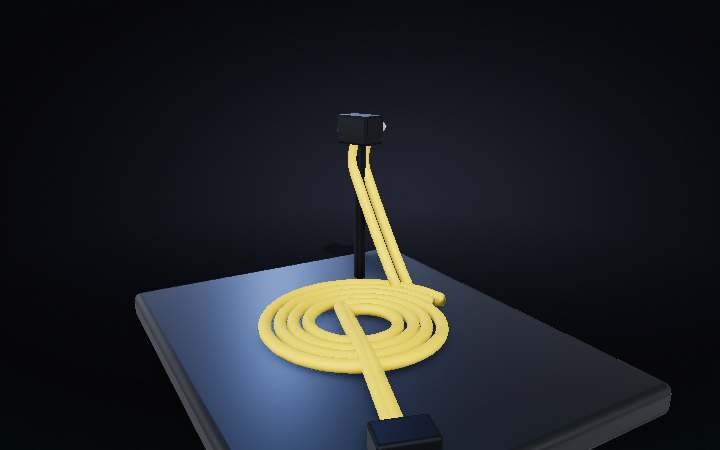
Step 01 of 07
A thread of glass carrying light
This coiled yellow cable looks like any other wire, but nothing electrical happens inside it. Instead a laser at one end blinks a beam of light down a glass thread thinner than a human hair, and a sensor at the other end reads it back — millions of times a second. This single cable is what actually carries most of the internet between continents.
Step 02 of 07
Where the precision actually is
Push the connector home and it clicks — but the plastic housing is not what matters. Inside sits a 1.25 millimetre ceramic ferrule holding the bare glass fibre dead-centre. Mate two connectors and it is those two ferrules, and the two fibre cores inside them, that must line up to a fraction of a hair's width. Miss it, even slightly, and light spills into the gap instead of crossing it.
Step 03 of 07
What is actually inside
Strip back the yellow outer jacket and there are three more layers before you reach anything that carries light: a soft coloured buffer coating, then the cladding — glass in its own right — and only at the very centre, the core. The core and cladding are really one continuous piece of glass, drawn together from a single rod; the difference that matters is invisible; a slightly different refractive index between the two.
Step 04 of 07
Total internal reflection
Light hitting the boundary between two clear materials usually just bends and carries on through. But hit it at a shallow enough angle and something else happens: refraction fails completely, and every last bit of light bounces straight back in. That is total internal reflection — no mirror, no coating, just glass meeting glass at the right angle. Skim a beam down the core at a shallow, grazing angle and it ricochets down the fibre for kilometres, losing almost nothing.
Step 05 of 07
One path, or many
Make the core wide enough and light can zigzag down it at several different angles at once — each one a valid "mode". That is multi-mode fibre: cheap and easy to work with, but those different paths cover slightly different distances, so a sharp pulse smears out over distance. Shrink the core down to a true single-mode thread and only one path fits at all — light travels in an almost dead-straight line, arriving as crisp as it left. That is the fibre that carries a signal across an ocean.
Step 06 of 07
Turning light into data
At each end of the link sits a small transceiver: a laser diode facing one fibre, a photodiode facing the other. The laser blinks on and off — sometimes over a billion times a second — writing a pattern of ones and zeros straight into pulses of light. At the far end the photodiode reads that same pattern back out as electrical pulses. Both directions run at once, each on its own strand, so the link talks and listens simultaneously.
Step 07 of 07
Run it
Laser blinking, photodiode reading, light ricocheting down the core by total internal reflection the entire way — a continuous stream of bits crossing however many kilometres of glass separate the two ends. It travels at roughly two-thirds the speed of light in a vacuum, close to 200,000 kilometres a second: fast enough to cross an ocean and back while you are still reading this sentence.