How a Gimbal Works
It doesn't hold the camera still by gripping it — three nested rings each absorb one rotation, so the payload never feels the frame move. Push it too far and the same trick can erase an axis: gimbal lock.
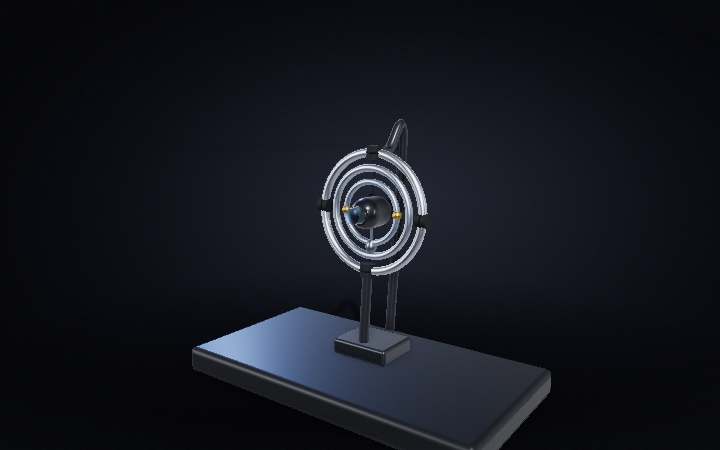
Step 01 of 06
1 · Decoupled, Not Clamped
That yoke is trembling right now — a few degrees of yaw, pitch and roll, the kind of shake a hand can’t help making. Watch the center instead: it never moves. Three nested rings sit between the shake and the payload, and each one only ever answers for a single rotation.
Step 02 of 06
2 · Three Rings, Three Axes
Yaw first: the outer ring alone swings to cancel it while the other two hold dead still. Then pitch — only the middle ring moves. Then roll — only the inner ring. Each ring is mechanically blind to the other two rotations, so each one only ever has one job.
Step 03 of 06
3 · Passive: Gravity Does the Work
No motor is running here — the small weight hanging under the payload does all the work. It pulls the payload’s center of mass below the pivot, so any tilt creates its own restoring torque — the same trick that keeps a ship’s compass level and a drink from spilling in a gimbaled cup holder. It settles a beat behind the shake instead of snapping ahead of it.
Step 04 of 06
4 · Active: IMU + Brushless Motors
Swap the weight for a sensor and the same three rings become a camera gimbal. An inertial measurement unit reads orientation hundreds of times a second; a small brushless motor sits at each ring, correcting within milliseconds of every nudge. Push it harder than gravity ever could, and it still doesn’t blink.
Step 05 of 06
5 · Gimbal Lock
Tilt the middle ring a full 90 degrees and something breaks: the outer ring’s axis and the inner ring’s axis now point the same way. Spin one, then spin the other — the payload sweeps the identical arc either way. The direction that used to sit between them, the one only a third ring could reach, is simply gone until the rig untilts.
Step 06 of 06
6 · Run It
Un-tilt, and all three axes come back independent. That is the whole trick: nothing clamps the payload — the rings simply give the shake nowhere to go, one axis surrendered to each ring, until two of them are asked for the same one.