How Gravity Works
An accelerometer in free fall reads exactly zero, and it is not broken. Nothing is pulling a falling thing down — what you feel as your weight is the floor shoving you off the path you would otherwise take.
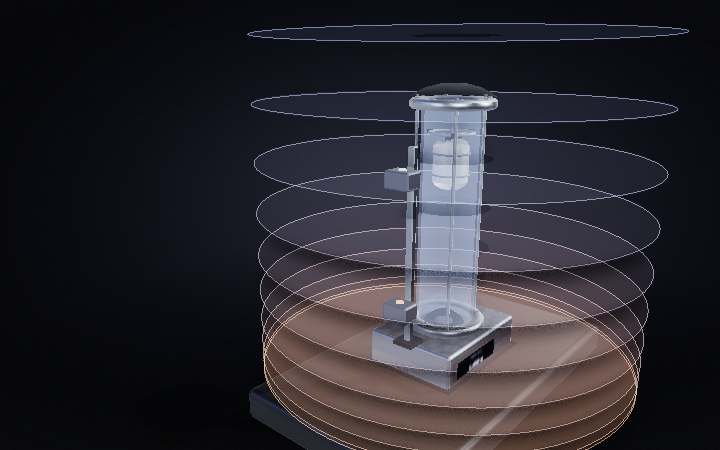
Step 01 of 09
1 · A capsule that is about to weigh nothing
This is a drop column — a glass tube with the air pumped out and a capsule hanging at the top of it. Inside that capsule is an ordinary accelerometer, the same kind of part that knows which way up your phone is. Held still, it reads 1.000 g. In a moment the clamp opens, and for the quarter-second it spends falling, that number will be zero. Nothing about the Earth changes in between.
Step 02 of 09
2 · What the instrument actually measures
Ghost the shell and there is one moving part: a tungsten proof mass slung on springs between two metal plates. Sitting on the bench it hangs low, closer to the bottom plate than the top. That is not gravity dragging it down. It is the bench pushing the case UP, and the springs taking a moment to haul the mass along with it. The gap between mass and plate changes, the electronics read that gap, and they call it 1.000 g.
Step 03 of 09
3 · Let go, and the force disappears
The clamp opens. Case and mass now fall at exactly the same rate, so the springs go slack and the mass drifts to dead centre. The readout says 0.000. That is the honest reading, not a broken one: a falling object has no force acting on it. What you feel standing on the floor was never gravity — it is the floor, refusing to let you fall. That push is the only thing your body has ever actually felt.
Step 04 of 09
4 · So what chooses the path?
If nothing pulls, something still has to decide where a free object goes. The answer is that mass and energy bend the geometry of spacetime, and anything left alone simply takes the straightest line that geometry allows. The lattice around the column is that geometry. Notice what it does not do: it does not sag like a sheet. Its planes crowd — evenly spaced far from the mass, packed tighter as they get closer to it.
Step 05 of 09
5 · The crowding is in time, not space
Each plane is one tick of a clock, so planes packed closer together mean a clock down there gets through fewer ticks — it genuinely runs slow. Not apparently: measurably. In 2010 two aluminium-ion clocks were compared with one raised 33 centimetres above the other, exactly the gap between these two heads, and they disagreed by about four parts in a hundred million billion. At that rate the upper clock needs roughly 900 million years to gain a single second.
Step 06 of 09
6 · A straight line through crowded time bends
Here is a thrown ball's path with time running left to right and height running up. It has to get from one end to the other, and every route it could take spends its seconds at different heights — and higher up, clocks run faster. But climb too high and you must move fast to get back down, and speed slows your clock again. The winning route is the exact compromise between those two, and it is the one the ball takes. That arc is not a fall. It is the path that ages the most.
Step 07 of 09
7 · At true scale it is almost perfectly straight
That drawing cheats. It makes two seconds about as wide as five metres are tall. Draw it honestly — one second of time is 300,000 kilometres across — and the arc flattens into something you cannot tell from a straight line. It is a piece of a circle whose radius is c²/g: 9.2 thousand million million metres, or 0.97 light-years. Every falling thing near Earth rides an arc of that same circle. Spacetime is barely bent at all. You only notice because you have spent your whole life watching one metre of it.
Step 08 of 09
8 · Run it sideways and it never lands
Nothing changes but speed. Give that same free path enough sideways motion and it closes into a loop: the object still takes the straightest line available, and the line simply comes back round. That is an orbit — falling that keeps missing. The probe riding it reads exactly what our capsule read inside the tube: 0.000 g. Astronauts do not float because gravity ran out. At the space station they still sit in about 90 percent of the pull you feel right now. They float because they are falling, and so is everything around them.
Step 09 of 09
9 · What is settled, and what is not
Everything you just watched is measured rather than argued — the zero reading, the clock gap, the orbit, each of them confirmed to many decimal places. What nobody can tell you is why gravity is so faint: between two protons it loses to electric repulsion by a factor of 10³⁶, a billion billion billion billion times over, and there is no accepted reason for it. Nor does anyone know what spacetime is made of. Relativity says it is smooth and bends; quantum mechanics says everything comes in grains and jitters. Both must be true somewhere, and no one has written down where.