How a Hydraulic System Works
A fist-sized gear pump lifts a tonne without effort, and it never makes pressure. It only pushes oil. The load decides how hard.
Step 01 of 07
A tonne on the end of an arm
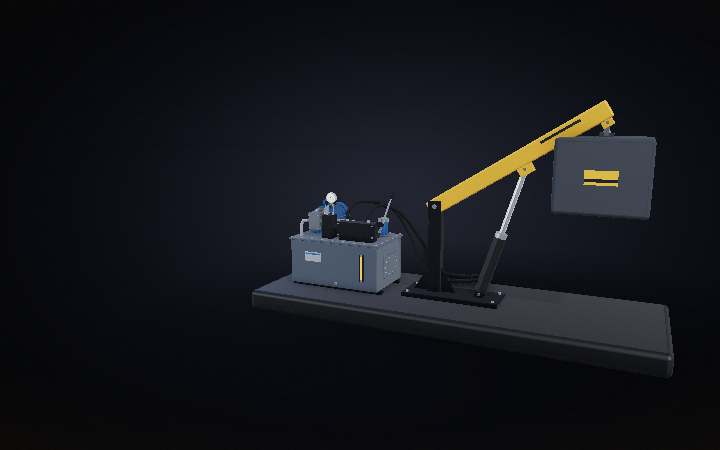
An electric motor sits on a steel tank of oil. Two hoses run from a valve block to a cylinder under a steel boom, and a one-tonne block hangs off the end. Pull the lever and the boom lifts the tonne smoothly and almost silently. Let go and it stops dead in mid-air. All of that work is done by oil.
Step 02 of 07
Two gears and a lot of oil
On the end of the motor shaft sits a gear pump: two twelve-tooth gears in a tight figure-eight case. The oil is not squeezed between the meshing teeth. It drops into the tooth gaps on the inlet side, rides around the outside of both gears against the case wall, and is pushed out where the teeth mesh again. Every turn moves the same 8 cc, about 12 litres a minute.
Step 03 of 07
Full flow, almost no pressure
With the lever centred the pump is still running flat out. Its oil goes into the valve, straight back out to the tank, and round again. Nothing stands in its way, so the gauge reads about 6 bar. The same valve has shut both hoses, so the oil on the lift side is locked in, still at the 70 bar it takes to hold the boom up. Oil barely compresses, so locked-in oil is as good as a steel prop.
Step 04 of 07
A spool decides where the oil goes
The lever slides a steel spool along a bore through the valve block. Its raised lands open some passages and seal others, and one move does three things at once. It shuts the path straight back to the tank, opens the pump to port A and the lift side of the cylinder, and opens port B, the other side, to the tank. Push the lever the other way and A and B swap.
Step 05 of 07
Pressure rises until the boom moves
Now the pump’s oil has nowhere to go but under the piston. The pressure climbs until it can lift the load and then stays there, about 70 bar for this boom and its tonne. That 70 bar pushes on every square centimetre of the 63 mm piston, about 2.2 tonnes of push in all. Lowering, the pump fills the smaller rod side instead, so the boom comes down about one and a half times faster.
Step 06 of 07
One spring sets the limit
Keep the lever pulled once the piston reaches the end of the cylinder and nothing can move. The pump keeps pushing the same flow, so the gauge needle shoots up. At 200 bar it pushes a small poppet off its seat against a spring, and all the flow pours back to the tank, its energy turned into heat. That spring sets the most this system can ever push: 200 bar on this piston is about 6 tonnes.
Step 07 of 07
Run it
Lift, hold, lower. The pump only ever makes flow, the same few cubic centimetres every turn. The valve chooses where that flow goes, and the load decides how hard it has to push, up to the limit the spring allows. The pump only pushes. The load decides the pressure.