How a Hydroelectric Plant Works
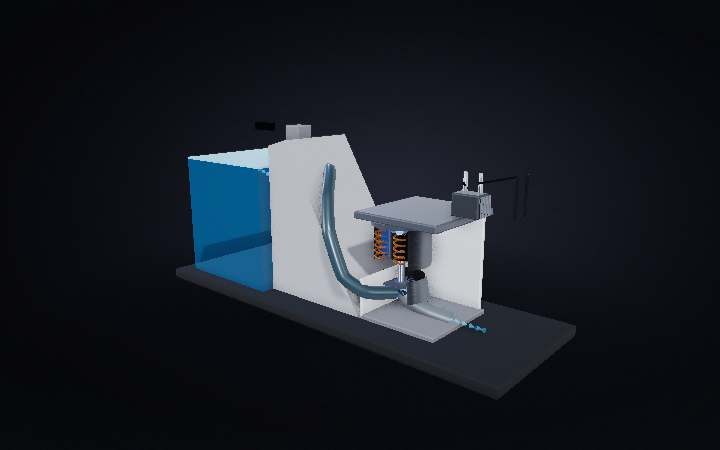
A dam trades a reservoir's height for speed down a penstock, spins a turbine and its generator, and sends the current out through a step-up transformer — gravity converted to grid power.
Step 01 of 08
The anatomy
A hydroelectric plant is a very simple machine at heart: a dam holds back a reservoir, a pipe called the penstock lets water fall from it, and at the bottom that falling water spins a turbine wired to a generator. Everything else — the transformer, the transmission lines — exists just to get the electricity that makes out to the grid.
Step 02 of 08
1 · The reservoir
The reservoir is stored energy — pure gravitational potential energy, sitting there as long as the dam holds it back. What matters is the HEAD: the height the water surface sits above the turbine downstream. Double the head and you double the pressure driving the turbine; a trash rack and intake gate keep debris out before the water is allowed to fall.
Step 03 of 08
2 · The penstock
Released, the water drops through the penstock — and trades that height for speed and pressure (potential energy becoming kinetic energy). The taller the dam, the faster the water is moving by the time it reaches the bottom, which is exactly why head matters so much to how much power a plant can produce.
Step 04 of 08
3 · The turbine
At the bottom, the flow enters a Francis turbine — the mid-head workhorse of hydropower. A spiral casing spreads the water evenly around the runner; a ring of guide vanes, bolted in place and never moving, aims it at the right angle; and just below them, the runner — the only part that actually spins — turns that racing water into torque on a shaft, as the flow bends from radial to axial. (Very low-head rivers use a propeller-like Kaplan turbine instead; very high-head sites use a Pelton wheel, struck by a free jet.)
Step 05 of 08
4 · The generator
The same shaft carries that spin straight up into the generator, where a rotor of magnetic poles turns inside a ring of fixed stator windings. As each pole sweeps past a winding, the changing field induces a voltage in it — Faraday's law, the same electromagnetic induction the transformer and inductor use, just driven by a spinning shaft instead of another coil's current. The result is alternating current, one pulse per pole per turn.
Step 06 of 08
5 · Step-up & the grid
That current is still at generator voltage — too low to travel far without huge resistive losses. A step-up transformer raises it dramatically before it heads out on transmission lines, trading current for voltage the same way any transformer does, so the wires can carry the same power at a fraction of the current. From here it's a story of substations and towers all the way to a wall socket.
Step 07 of 08
6 · The tailrace
Its energy spent, the water leaves the runner through the draft tube — which gently slows it back down to recover any last usable pressure — and rejoins the river downstream as the tailrace. Nothing is consumed in this whole chain, only converted: height became speed, speed became spin, spin became current.
Step 08 of 08
The plant runs
Head, penstock, turbine, generator, transformer, tailrace — one continuous energy chain, from a reservoir sitting still to electrons moving down a wire. Every hydro plant on Earth, from a village micro-turbine to Three Gorges, is this same handful of ideas at a different scale.