What’s Inside the Earth
The deepest hole ever drilled stopped at 12 km, 0.2% of the way down. Yet we know the centre is a solid iron ball as hot as the Sun’s surface, because earthquakes X-ray the planet and the liquid core casts a shadow.
Step 01 of 08
Everything you’ve ever stood on
This is the whole planet, 12,742 km across. Every rock anyone has ever held, every mine and every well, came out of a thin skin on the outside of it. Yet we know what is at the very centre. Nobody has ever been anywhere close.
Step 02 of 08
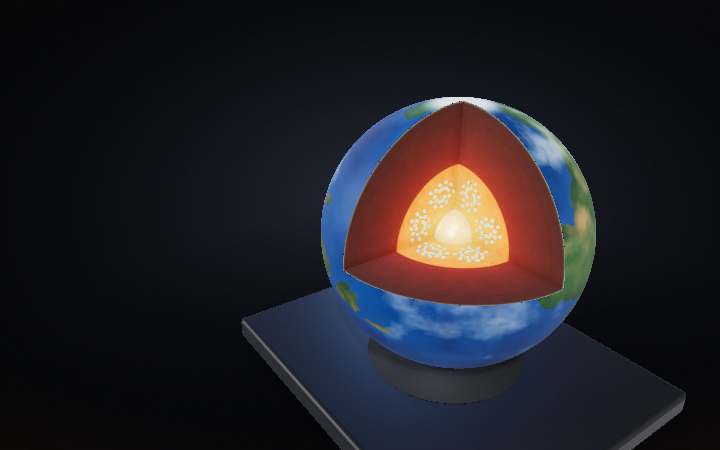
Cut it open
Take out a wedge and the planet turns out to be layers, drawn here at true scale. A rocky crust too thin to see. Then 2,900 km of mantle: solid rock, glowing hotter the deeper it goes. Then a core of iron and nickel in two parts: an outer core that is liquid, and an inner core that is solid.
Step 03 of 08
The deepest hole ever drilled
The crust is 5 to 10 km thick under the oceans and 30 to 50 km under the continents. Compared with the planet, that is thinner than the skin of an apple. The deepest hole ever drilled, the Kola borehole in Arctic Russia, took 19 years to reach 12.3 km. The rock at the bottom was 180 °C and soft enough to creep into the hole. It never got through the crust: that is 0.2% of the way to the centre.
Step 04 of 08
Solid rock that flows
The mantle is 84% of the Earth’s volume, and it is solid rock. But it is heated from below by the core and cooled from above, and over millions of years it creeps. Hot rock rises, spreads out under the crust, cools, and sinks again, a few centimetres a year. That slow churn is the engine under the plates on the surface.
Step 05 of 08
How we know: earthquakes
Nobody can go down there, so we listen instead. Every big earthquake sends waves through the whole planet, and seismometers around the world time them. P waves push and pull, and cross solids and liquids alike. S waves shake the rock sideways, and a liquid cannot carry that. So every S wave that reaches the core dies there, and a huge band on the far side of the Earth never feels one. That shadow is how we know the outer core is liquid.
Step 06 of 08
A liquid-iron dynamo
The outer core is 2,260 km of molten iron and nickel at around 4,000 to 5,000 °C, churning as the planet cools and spins. Moving liquid metal carries electric currents, and those currents make the Earth’s magnetic field: the loops that reach out into space and swing every compass on the surface.
Step 07 of 08
A solid ball as hot as the Sun
At the centre is a ball of iron and nickel about 2,440 km across, at roughly 5,400 °C: about as hot as the surface of the Sun. At that heat it should be liquid. It stays solid because it is under 3.6 million atmospheres of pressure, which raises iron’s melting point higher still. In 1936 Inge Lehmann noticed faint P waves arriving inside the shadow, where none should be. Something inside the core was bending them there. It was this ball.
Step 08 of 08
Everything below 12 km, we heard
Put the wedge back and it is just a planet again. The flowing mantle, the liquid core, the solid ball at the centre: every layer has been mapped without anyone going deeper than 12 km. We worked it all out by listening.