How a LiDAR Sensor Works
A spinning black can on the roof of a self-driving car, firing invisible five-nanosecond flashes and timing how long they take to come back — sixty-four stopwatches building a 3D map out of nothing but arithmetic.
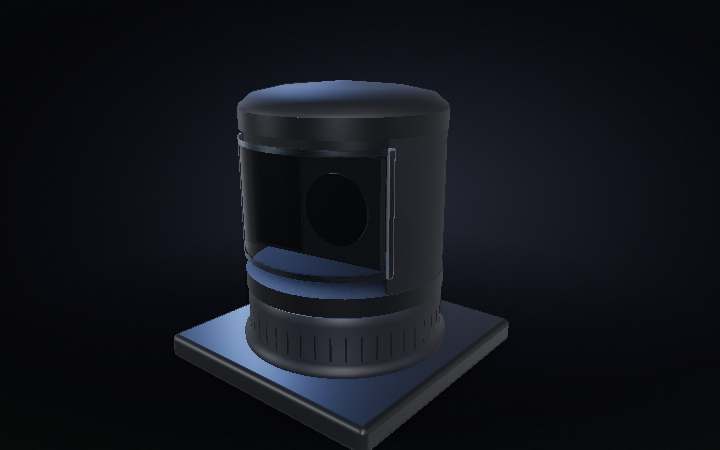
Step 01 of 08
The can on the roof
Every self-driving prototype has worn one of these: a black cylinder the size of a coffee tin, turning steadily all day. There is no lens you can look into and no picture coming out of it. The only thing it ever measures is time — and from time alone it builds a three-dimensional map of everything around the car.
Step 02 of 08
No camera in here at all
Open the housing and there is nothing resembling an image sensor. On one side sit two blocks of laser diodes, thirty-two in each, staring out through their own window. On the other side a single fat lens collects light and drops it onto a detector board. Underneath, a motor spins the whole optical assembly on a bearing while the base stays bolted still.
Step 03 of 08
Fire, and start a clock
Here is the entire measurement, slowed down about a hundred million times. One diode fires a flash of infrared lasting five billionths of a second. The flash crosses to whatever is out there, scatters off it, and a sliver of it finds its way back into the receiving lens. Halve the round-trip time, multiply by the speed of light, and that is the distance. Nothing was recognised; nothing was photographed.
Step 04 of 08
Why this is a clock problem
Light covers thirty centimetres every nanosecond. That white bar is drawn at true scale: it is exactly one nanosecond of flight. So the round trip from a car a hundred metres ahead lands back in 667 nanoseconds — and to call that distance to within two centimetres, marked here in green, the electronics have to resolve 130 trillionths of a second. The hard engineering is not the laser. It is the stopwatch.
Step 05 of 08
What comes back is almost nothing
The beam spreads as it travels — two milliradians, about a twenty-centimetre patch by the time it reaches a car ahead. It scatters off dull paint in every direction, so only a wisp of the original flash returns. What lands on the detector can be a handful of photons. An avalanche photodiode answers by letting one arriving photon trigger a cascade of electrons, turning a single particle of light into a spike you can actually time.
Step 06 of 08
One beam is only one line
A single laser measures a single direction, which draws you a line, not a world. So sixty-four of them are bolted into those two blocks, each aimed at its own fixed vertical angle, fanning out a blade of beams 26.8 degrees tall. They fire in sequence, top to bottom, thousands of times a second — and every beam owns its own detector, so none of them can be confused for another.
Step 07 of 08
Now spin it
The motor turns the whole head fifteen times a second, and the fan sweeps the full circle with it. Each measurement arrives stamped with the angle the head was at and the angle its laser is fixed at, so a distance becomes a point in space. Watch the floor: the beams land in rings, and the blocks carve holes behind them where nothing came back. That is the picture — 1.3 million dots a second, drawn by rotation rather than by any lens.
Step 08 of 08
A stopwatch on a turntable
Sealed back up, it is a black can doing one thing very fast: timing flashes of light. That is also exactly why it fails where it does. Fog and heavy rain scatter the pulse before it arrives, matte black paint absorbs it, and a wet road bounces it away instead of back. No echo, no point — which is why nobody drives on lidar alone.