What Happens When You Flip a Switch
Flipping a switch sends nothing anywhere. The electrons were already in the filament — on AC they never leave. What races down the wire is the push.
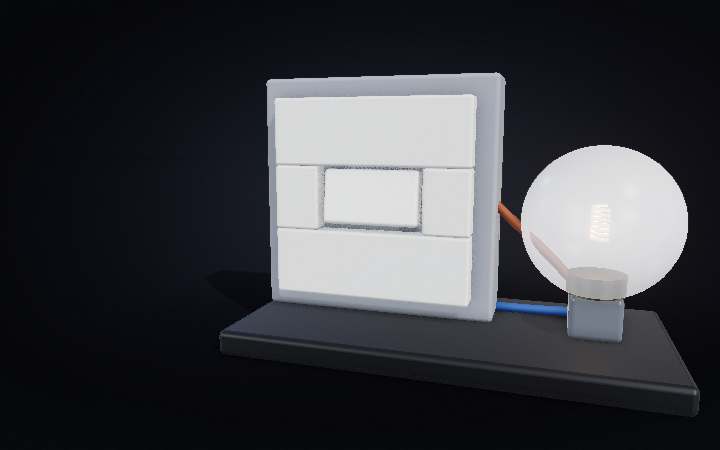
Step 01 of 07
The most boring object in your house
A square of plastic and a rocker that moves about two millimetres. You have pressed one a hundred thousand times without once wondering what it actually does. It does not make electricity, and it does not send any. It has exactly one job: to open and close a gap.
Step 02 of 07
A lever, a spring, and two pieces of metal
Behind the plate sits a steel back box, and inside it there is almost nothing. A brass terminal where the live wire arrives from the grid, a second terminal feeding the lamp, and between them a sprung steel blade carrying a small silver pad. When the pad touches its partner, current flows. When it does not, it does not.
Step 03 of 07
Why it snaps instead of sliding
Watch the contacts, not the rocker. The rocker moves at whatever speed your finger moves, but the contacts do not follow it — they hold, and then fly. A small spring loads up until the rocker pushes it past its own centre line, and the blade slams across in a couple of thousandths of a second. That speed is the whole point: a slowly closing contact draws an arc, and an arc would burn the silver away in weeks.
Step 04 of 07
The loop was always there
Closing that gap does not start a delivery. The live wire was already sitting at full voltage on one side of the contacts, all day, whether the lamp was on or not. The lamp, its filament and every centimetre of copper between them were already packed with electrons. The only thing missing was a complete loop — and the switch is the one millimetre of it you are allowed to touch.
Step 05 of 07
The electrons were already there
This is a single strand of that copper, blown up enormously. The orange cores are copper atoms locked in a lattice; the blue specks are the free electrons drifting between them, and there are roughly as many of them as there are atoms. They do not travel from the power station. They were manufactured into this wire, and they will die in it.
Step 06 of 07
Nothing travels. The push travels.
On alternating current the electrons never even drift anywhere — they shudder back and forth in place, fifty times a second, moving a few millionths of a metre each way and ending exactly where they began. What actually races down the wire is the electric field: the push. It covers the distance at a large fraction of the speed of light, which is why the lamp is instant while the electrons are effectively standing still.
Step 07 of 07
And the grid feels you do it
Nothing on the grid is stored. There is no tank of electricity waiting behind your wall, so the instant you close that gap the demand runs all the way back up the line — and somewhere a turbine leans into it, a fraction harder than it did a moment ago. A square of plastic and a rocker, and it reaches four hundred kilometres.