How a Lithium-Ion Battery Works
Nothing inside is burned or used up — it is a shuttle. Lithium ions cross back and forth between two layered electrodes, and the cell ages fastest exactly where most phones sit overnight: parked at 100%.
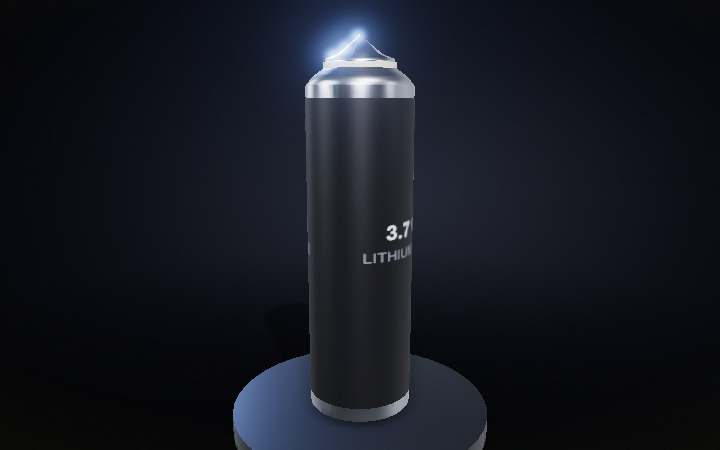
Step 01 of 08
1 · The cell
This is a rechargeable lithium-ion cell in the classic 18650 format — 18mm across, 65mm tall, the same size cell behind laptops, power banks and most EVs. It is not a fuel tank: nothing inside gets burned or used up. It is a container for two electrodes and a shuttle of lithium ions that crosses between them, back and forth, thousands of times.
Step 02 of 08
2 · Inside: the jelly roll
Peel the steel can away and it is one long sandwich, wound tight: an aluminum foil coated with a layered lithium metal oxide (the cathode), a copper foil coated with graphite (the anode), and a porous separator between them, the whole thing soaked in liquid electrolyte. Winding it packs an enormous amount of electrode surface into a can you can close your hand around.
Step 03 of 08
3 · Charging: ions leave the cathode
Plug in a charger and it pulls lithium ions out of the cathode's layered lattice. They cross the electrolyte, slip through the separator's pores, and wedge themselves between the graphite anode's stacked layers — intercalation. Electrons cannot make that crossing, so they take the only other path: out through the wire, around the external circuit, back in at the anode. That electron flow through the wire IS the charging current.
Step 04 of 08
4 · Discharge: the same shuttle, reversed
Unplug it and use the phone, and the whole thing runs backward: ions leave the graphite layers and drift back to the cathode, while electrons flow anode to cathode through the external circuit again — only now that circuit is your phone, and those electrons ARE the power. Nothing was consumed on the trip either way. A lithium-ion cell does not get 'used up' like fuel; it moves the same ions across the same gap, again and again.
Step 05 of 08
5 · Ageing: the price of staying full
Every trip across that gap leaves a little residue. On the anode, a film called the SEI layer forms and keeps thickening, quietly eating capacity and raising resistance. On the cathode, staying above roughly 4.1 volts — about 80% state of charge — puts the lattice under real structural stress and speeds up electrolyte breakdown. Neither is dramatic in one charge. Parked at 100% for hours, every day, they add up.
Step 06 of 08
6 · Fast, cold charging: plating instead of intercalation
Charge too fast, or charge a cold cell, and lithium ions arrive at the anode faster than they can slot cleanly between the graphite layers. Some plate out as metallic lithium on the surface instead — a reaction that does not reverse. Enough of it grows into microscopic dendrites reaching back across the gap, and a dendrite that reaches the cathode side punches through the separator and shorts the cell. That is the mechanism behind the battery-fire stories.
Step 07 of 08
7 · Why 20-80% roughly triples the cycles
Cycle a cell between about 20% and 80% and it barely visits the high-stress top of its voltage range — no long stretches above ~4.1V, and no deep dips near empty either. Do that instead of habitually charging to 100% and it can take a cell from around 500 full cycles to 1500 or more before it noticeably fades: roughly three times the working life, out of the same physical cell.
Step 08 of 08
8 · Doing its job, quietly
Reassembled, this is the same cell sitting behind the glass of your phone or laptop right now — never burning anything, just shuttling the same lithium ions back and forth, one intercalation at a time. The ions do not wear out. The lattice they are parked in does — and where you park it, how full, how hot, how fast, is up to you.