How a Speaker Works
A coil of wire, a heavy magnet and a paper cone — how an electrical wiggle becomes a sound you can feel in your chest.
Step 01 of 06
The anatomy
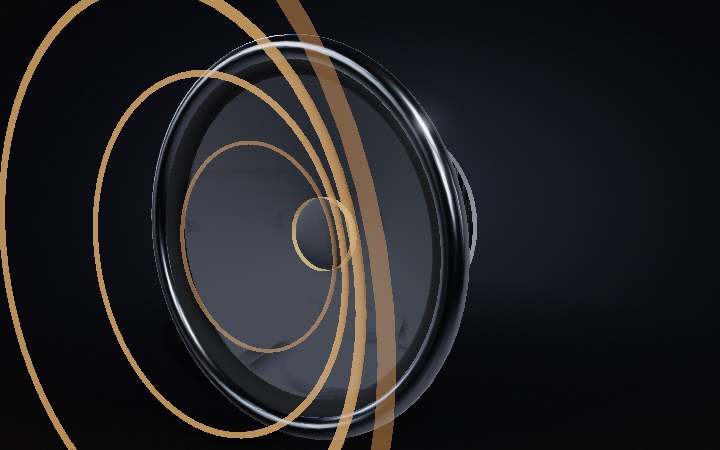
A speaker driver is a simple electric motor that runs in a straight line. A stiff paper cone hangs in a metal basket; behind it a heavy magnet, and dropped into the magnet a lightweight coil of copper wire. Feed the coil the wiggling current from an amplifier and the cone punches the air — that pressure wave is the sound.
Step 02 of 06
The voice coil
The amplifier sends an alternating current through the coil, an exact copy of the sound waveform. Current one way makes the coil an electromagnet with its north pole up; reverse the current and it flips. Thousands of times a second, the coil's own magnetic field swings back and forth.
Step 03 of 06
Magnet vs. coil
The coil sits in a narrow gap where the permanent magnet packs a strong, steady field. Any wire carrying current through a magnetic field feels a force — current one way drives the coil straight up out of the gap, current the other way drives it straight back in. The magnet is heavy and fixed; the featherweight coil is what actually moves.
Step 04 of 06
The cone moves air
The coil is glued to the cone, so every push and pull travels straight to the paper. Driven out, the cone shoves a puff of air forward and squeezes a high-pressure zone; pulled back, it leaves a low-pressure one behind. That chain of pressure highs and lows racing outward is exactly what your ear hears as sound.
Step 05 of 06
The suspension keeps it honest
Two springs hold everything in line. The rubber surround seals the cone rim to the basket; the corrugated cloth spider does the same down at the coil. Together they let the cone travel freely in and out but stop it wobbling sideways — so the coil never scrapes the gap and always returns to dead centre.
Step 06 of 06
Music, made of air
Real music is a blur of frequencies, so the current — and the cone — never settle into a single tone. Bass notes swing the cone in big slow strokes, treble in tiny fast flutters, all at once. From a wiggle of electricity to a wave you can feel: that is a loudspeaker.