How a Manual Gearbox Works
Five speeds, three shafts and a brass ring that kisses gears up to speed — how a stick-shift trades engine revs for wheel torque.
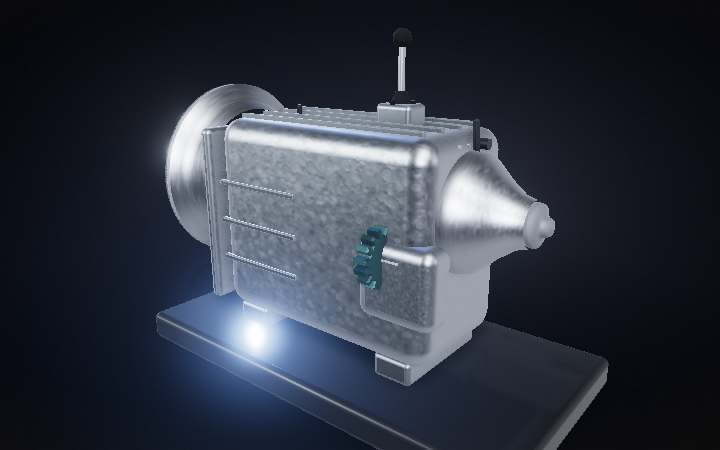
Step 01 of 09
The box between engine and wheels
An engine is only happy spinning fast — a few thousand turns a minute — but your wheels need anything from a crawl to a cruise, and pulling away takes far more twist than an engine makes on its own. This aluminium box solves both problems with nothing but gears: five ratios forward, one reverse, chosen by hand. From the outside only three things move: the input shaft spun by the clutch, the lever in your palm, and the output flange turning the driveshaft.
Step 02 of 09
Three shafts do everything
Lift the case away and the whole machine is three shafts. The input shaft brings power from the clutch to one head gear. That drives the layshaft below — a rigid cluster of gears machined as a single piece. Each cluster gear meshes with a partner riding on the mainshaft above. Right now the box is in neutral: the engine spins the cluster and every gear on it, yet the mainshaft between them stands perfectly still. Nothing is locked together — that is the whole trick.
Step 03 of 09
Trading speed for force
Pick first gear. A 15-tooth pinion on the cluster drives a 35-tooth gear on the mainshaft; count the whole path — 20 teeth into 30, then 15 into 35 — and the engine turns exactly 3.5 times for every single turn of the output. A gearbox never creates power: it trades speed for torque, and in first that trade multiplies the engine’s twist three-and-a-half times — enough to get a tonne and a half rolling from rest.
Step 04 of 09
Always meshed, never grinding
Every forward pair stays permanently engaged — hence “constant mesh”. The secret is that the big gears are not fixed to the mainshaft at all: each freewheels on needle rollers, spun constantly by the cluster at its own ratio’s speed. Look closely — neighbouring gears turn at visibly different rates around the same still shaft. Beside each one sits a small ring of stubby dog teeth: the only handle the shaft will ever grab.
Step 05 of 09
The synchromesh handshake
To engage a gear, a collar splined to the mainshaft — the sleeve — slides toward it. It cannot simply slam in: gear and shaft are spinning at different speeds. So it first presses a brass blocker ring onto a steel cone on the gear. Friction on that shallow taper drags the gear — and the whole cluster behind it — to the shaft’s exact speed, and only when the speeds match will the ring’s chamfered teeth let the sleeve slip home over the dog teeth. Match, block, engage: a tenth of a second, entirely by feel.
Step 06 of 09
What the lever actually moves
Your hand never touches a gear. The lever rocks one of three rails running along the top of the box; each rail carries a fork riding in a groove on one sleeve. Push, and the fork slides its sleeve out of first, through neutral, and into the synchro’s handshake with second. Watch the whole chain at once: fork forward, ring flaring hot as it drags the cluster to half speed, sleeve home — while the mainshaft coasts on, steady, carrying the car.
Step 07 of 09
Backwards is a special case
There is no synchro for reverse — which is why it only goes in at a standstill. A third gear, the idler, rides on a stub shaft carried by an arm that pivots on the 5-reverse rail; push the lever across and the whole linkage swings it down into mesh, bridging the cluster and a gear fixed to the mainshaft. One extra gear in the chain flips the direction of rotation: idler in, and the output turns backwards at a stump-pulling 3.2 : 1. These three are the only straight-cut spur gears in the box — simple and strong, and the reason reverse whines while the helical forward gears run quiet.
Step 08 of 09
What the five speeds actually are
Here is the whole set, one at a time, with the cluster held at a single steady speed so the only thing changing is what comes out the far end. First is a 15-tooth pinion driving a 35-tooth gear — the biggest reduction in the box. Second and third are progressively closer matches, until third is 25 teeth into 25: one turn of the cluster, one turn of the mainshaft. Fourth drives no gears at all — the sleeve locks the input shaft straight to the output, one to one. And fifth runs the trade backwards: 32 teeth driving 18, so the output turns faster than the engine. That is overdrive, and it is why fifth is for cruising, not for climbing.
Step 09 of 09
Up through the box
Now drive it. Pulling away, road speed climbs steadily — so it is the engine that has to step, and you can watch it happen: revs dip as the clutch comes back in, the lever crosses to a new rail, a fork slides a sleeve, and the rest of the box falls dark around whichever pair has picked up the load. First, second, third, fourth, fifth — five mechanical trades between fuel and road, and the only one that puts no gear pair to work at all is fourth, where the whole set goes dark at once.