How a Mechanical Watch Works
A coiled spring, a train of tiny gears, and a heartbeat of steel — how a wristwatch turns stored energy into perfectly measured time, with no battery at all.
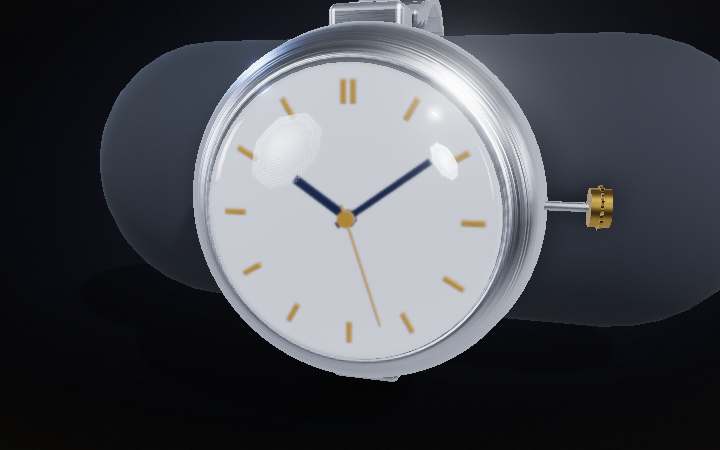
Step 01 of 08
1 · The face
One of the smallest machines most people will ever own, and from the outside the job looks simple: three hands, twelve marks, one knob. The hour and minute hands creep too slowly to see, but watch the seconds hand — it doesn't jump once a second like a quartz watch. It sweeps, in a stream of tiny steps, because it is wired straight to a mechanical heartbeat underneath. The knob at the side is the crown: twist it and you are literally winding the machine's fuel tank. Scroll down and we'll take it apart, one layer at a time.
Step 02 of 08
2 · Inside the case
Lift off the dial and hands, and here is the machine itself. It's a chain of parts, each handing power to the next: a wound mainspring in the barrel pushes a train of gears; the last gear, the escape wheel, is held in check by the pallet fork; and the fork is governed by the swinging balance wheel. Follow the chain with us — power first, timekeeping last.
Step 03 of 08
3 · The mainspring
Winding the crown coils a flat ribbon of spring steel tighter and tighter inside the barrel. That is the watch's entire fuel tank — a few turns of the crown store enough energy to run it for a day or two. As the spring slowly unwinds, it turns the barrel, and the barrel's teeth push the first wheel of the train.
Step 04 of 08
4 · The gear train
The barrel turns slowly with great force; the train trades that force for speed. Each wheel drives a tiny pinion on the next, spinning it faster and faster — barrel to centre wheel to third to fourth. By the fourth wheel the ratio is set so it turns exactly once per minute, which is why the seconds hand rides on it.
Step 05 of 08
5 · The escapement
If nothing stopped it, the spring would unwind in seconds. The pallet fork is the gatekeeper: its two ruby jewels catch the escape wheel's teeth, holding the whole train frozen. Only when the balance nudges the fork does one tooth slip past — tick — before the other jewel locks the very next tooth. The train advances one tooth at a time, and every unlock is a beat.
Step 06 of 08
6 · The balance wheel
This is the heartbeat. The balance wheel swings back and forth on a fine spiral hairspring — wind it one way, the spring pulls it back, exactly like a pendulum but immune to gravity. It beats at a fixed rate, typically eight times a second. Each swing, its jewel kicks the pallet fork to release one tooth, and in return the escapement gives the balance a tiny push to keep it swinging. The balance decides the speed; everything else obeys.
Step 07 of 08
7 · Back to the hands
Put the dial back on and the whole chain hides behind three moving pointers. The fourth wheel turns once a minute, so the seconds hand simply rides its axle. A small side train of reduction gears — the motion works — slows that same rotation down 60× for the minute hand and 720× for the hour hand. Every sweep of the seconds hand you see is the balance wheel's beat, delivered to the surface.
Step 08 of 08
The whole watch
Spring to barrel to train to escape wheel to fork to balance — and the balance metering it all back into a steady tick that ripples up to the hands. Wind it once and this conversation between a spring and a swinging wheel repeats hundreds of thousands of times a day, keeping time to within seconds, on a machine small enough to forget you're wearing.