How a Microwave Oven Works
A vacuum tube that spins electrons in circles, a metal box that bounces the result into a standing wave, and water molecules flipped two and a half billion times a second — the physics inside every kitchen counter.
Step 01 of 07
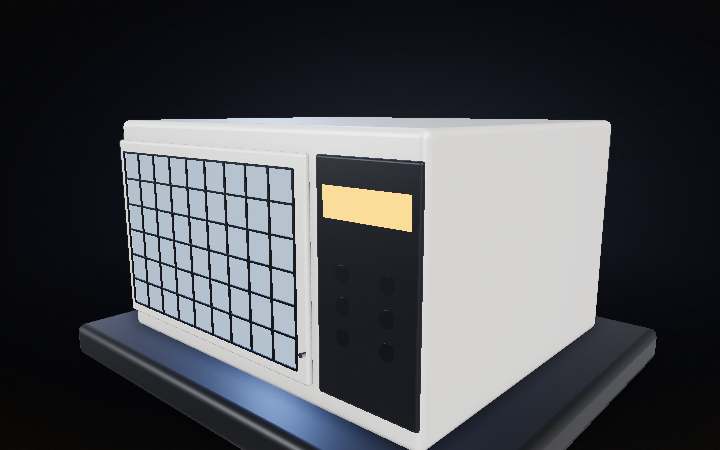
A sealed box that cooks with radio waves
Close the door and the whole machine disappears behind smooth plastic and a glass window. Nothing on the outside explains how it works — there is no flame, no glowing element, nothing touching the food at all. Everything that actually does the cooking is a vacuum tube the size of a fist, hidden inside the roof of the box.
Step 02 of 07
Three parts, one job each
Strip the shell away and it is just three things: a turntable that carries the food, a magnetron tucked in the roof that manufactures the microwaves, and a short metal duct — the waveguide — that pipes them down into the cavity. Everything else is empty space and reflective metal walls.
Step 03 of 07
A vacuum tube that spins electrons in circles
At the centre sits a heated cathode, glowing enough to boil electrons off its surface. Two ring magnets sandwich a block of copper cut with twelve resonant cavities, and their magnetic field forces those electrons into curved, looping paths instead of a straight line to the copper. A rotating bunch of electrons — a "spoke" — sweeps past the cavities and rings them like tuning forks, all locked to exactly 2.45 billion cycles a second.
Step 04 of 07
Piping the wave into the box
An antenna loop taps the oscillation straight off the cavities and feeds it up into a short metal duct — the waveguide — which carries it down into the cooking cavity. A small stirrer fan spins at the feed point, scattering the wave further before it ever reaches the turntable below.
Step 05 of 07
Why the plate has to spin
Inside a sealed metal box, microwaves cannot just travel outward and disappear — they bounce off every wall and pile up into a fixed pattern of peaks and troughs, a standing wave. Sit food at a trough and it barely warms; sit it at a peak and it scorches. A turntable is the low-tech fix: it drags every part of the food through both, again and again, until the average comes out even.
Step 06 of 07
The actual heat: molecules forced to flip
Water is a polar molecule — slightly positive on one end, slightly negative on the other — so it twists to follow an electric field. The microwave field reverses 2.45 billion times a second, and every water molecule in the food tries to flip in step with it. That forced, frantic rotation is friction at the molecular scale, and friction is heat. It builds fastest near the surface; the centre catches up only by ordinary conduction.
Step 07 of 07
Run it
A tube that turns heat into spinning electrons, electrons that ring twelve tiny cavities into a radio wave, a box that bounces that wave into a standing pattern, and a turntable that just keeps things moving through it. No flame, nothing touching the food — just water molecules forced to dance.