How 2G, 3G, 4G, 5G and 6G Work
A radio wave has not got faster since 1901, and Shannon's limit has not moved a decibel. Every G is the same steel mast buying speed with the same three coins — a wider slice of spectrum, a denser alphabet, more copies of the signal sent through space at once. What actually changes each time is how the network stops you waiting your turn.
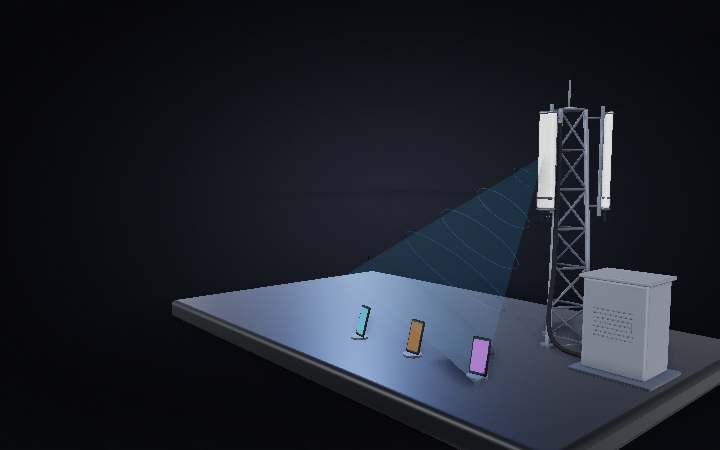
Step 01 of 09
The same steel, five times over
Almost nothing on a cell site is new. The lattice mast, the cabinet at its foot and the cable trench between them went in for voice calls in the nineties, and they are still holding up whatever the network is called this decade. What actually changes is the panel on the arm — that one white slab, and the arithmetic running through it. Everything a G number promises happens in there.
Step 02 of 09
2G: eight turns on one channel
A GSM channel is 200 kilohertz wide — narrower than a single FM radio station. Eight phones share it by literally taking turns: the second is cut into bursts, you get one burst in eight, and you are silent for the other seven. That is why 2G data dripped. One timeslot carries about 9.6 kilobits a second, so a single phone photo would have taken you over an hour.
Step 03 of 09
3G: everybody talks at once
3G's idea was to abolish turns altogether. The channel widens to 5 megahertz — twenty-five times the room — and all three phones transmit across the whole of it at the same instant. What keeps them apart is not time but a code: each phone multiplies its bits by its own fast pattern of plus and minus, 3.84 million flips a second. On the air that is one hash. Multiply the hash by one phone's code and its bits fall back out, while everyone else averages to nothing.
Step 04 of 09
4G: turns again, a thousand a second
LTE brings turns back and makes them tiny. The 20 megahertz channel is sliced in both directions at once — into subcarriers 15 kilohertz apart and slots half a millisecond long — and what falls out is a grid of tiles. A scheduler in the cabinet re-deals that whole grid every millisecond, handing each phone whatever tiles its signal can currently carry. Nobody waits for a turn any more. They wait a thousandth of a second for the next deal.
Step 05 of 09
The second lever: more bits per wiggle
Width alone was never going to do it. The other half of the gain is the alphabet — how much meaning you pack into one flick of the wave. Every symbol is a point on this grid of amplitude and phase: four points carry two bits, two hundred and fifty-six carry eight. But the noise smudging each point does not shrink as you add more of them. Crowd the constellation and the smudges touch, the receiver starts guessing, and the network quietly drops you back to a coarser alphabet.
Step 06 of 09
5G: sixty-four antennas, one beam each
Here is the lever 5G actually leans on. The slim white panel is gone, replaced by a box the size of a briefcase with sixty-four transceivers behind its face — sixteen across, four down. Delay each one by a fraction of a wavelength and the waves reinforce in exactly one direction: a beam, aimed at one phone, steered in software with nothing moving. Three phones get three beams, and because the beams barely touch, the tower can hand all three of them the same tile at the same moment.
Step 07 of 09
Why any of it got faster
Nothing here made radio faster. A wave still travels at the speed it did in 1901, and the ceiling Claude Shannon put on a noisy channel has not moved a decibel. Speed is three numbers multiplied: how wide the channel is, how many bits ride on each symbol, and how many separate copies of the signal the antennas can fly at once. 2G had 200 kilohertz, one bit a symbol and one stream. 5G has up to 400 megahertz, eight bits, and dozens of beams — about two million times the peak rate, off the same steel.
Step 08 of 09
6G: a beam that already knows where you are
There is no 6G to buy. It is a set of arguments happening right now: the first specifications are due out of 3GPP at the end of 2028, service around 2030, and the shortlist of bands runs from seven to fifteen gigahertz — shorter waves, far more room, noticeably less reach. The interesting part is not the speed. A tower already firing narrow beams can listen for their echoes, and a network that hears its own reflections can map the street it stands on. The radio becomes a radar that happens to carry your data.
Step 09 of 09
Run it
One mast. Five generations bolted to it in thirty years, each buying the same three things — a wider slice, a denser alphabet, more beams at once. Watch the panel change and the channel grow, and notice what never moves: the steel, the physics, the speed of the wave itself. The wave never got faster. The queue did.