How a Lock Works
Five springs, five pins and a gap four thousandths of an inch wide — why your key opens the door, and why a bent piece of wire opens it too.
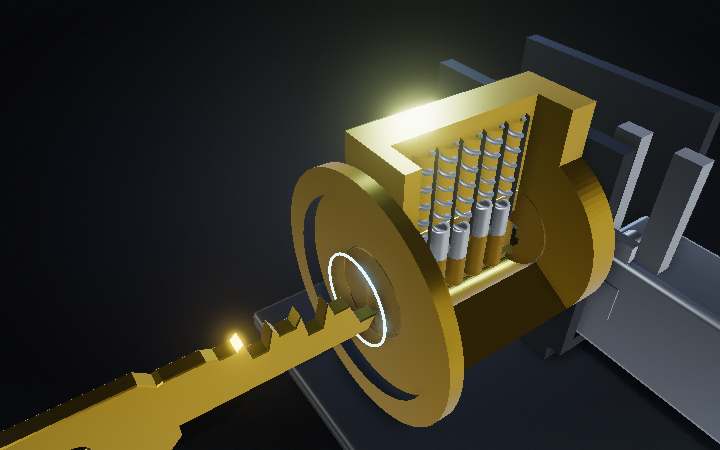
Step 01 of 08
The thing on your door
A deadbolt: a brass cylinder, a steel case, and an inch of hardened bolt buried in the door frame. Push the right key in, turn it half a revolution, and the bolt slides back out of the wall. From out here it looks like the lock is reading your key — comparing it against something it remembers. It is not. There is nothing in there that can read.
Step 02 of 08
A cylinder inside a cylinder
Cut it in half and the lock turns out to be two cylinders. The outer one — the shell — is fixed in the door. The inner one — the plug — carries the keyway, and with its chambers still empty it simply spins, winding the bolt in and out as it goes. All that separates the two is a running clearance about four thousandths of an inch wide: the thickness of one sheet of paper. That gap is the whole lock.
Step 03 of 08
Five pins in the way
Now fill those chambers. Each takes a spring, a nickel driver pin, and a brass key pin underneath it, and the chambers run straight down through the shell and on into the plug. Pull the key out and the springs shove every stack down, so each driver pin ends up half in the shell and half in the plug — five steel pegs pinning the two cylinders together. Lean on the plug now and it moves a fraction of a degree and stops dead.
Step 04 of 08
The key is five ramps
A key is not a password — it is a row of machined heights. Each cut lifts its own key pin by exactly the amount that puts the joint between key pin and driver pin level with the shear line. Watch the pins bob as the blade slides past them: every cut lifts every pin it passes, and they only land together when the key is all the way home. Five splits, one line, nothing left crossing it.
Step 05 of 08
Half a turn, one inch of bolt
With the gap clear, the plug simply turns — a full half revolution, key and all, while the driver pins sit up on the shear line, stranded. Its tail carries a crank pin, and that pin rides in the fork on the back of the bolt: half a turn of rotation becomes an inch of straight-line travel, and the bolt pulls out of the door frame. Everything else in this lock exists to permit that half turn.
Step 06 of 08
A wrong key fails like a stick
This key fits the keyway and is cut wrong in two places. Chamber two is left short, so its driver pin still bridges the gap. Chamber four is cut too shallow and overlifts, so now the key pin itself pokes across. Three of the five chambers are perfect and the plug still will not move. Nothing was compared, nothing was rejected — there is simply metal in the way again.
Step 07 of 08
The flaw is the drilling
Those five chambers cannot be drilled perfectly in line — the tolerance is around a thousandth of an inch. So when a wrench puts turning pressure on the plug, one chamber pinches its driver pin before any other. Lift that one pin to the shear line and the plug creeps a fraction of a degree; the driver drops onto the edge of the plug and stays there. Now the next pin binds. Five one-pin puzzles, solved in whatever order the factory decided — and no key involved.
Step 08 of 08
Springs, pins and a gap
Put it back together and nothing about it changes. Five springs, five pairs of pins, a cam, and four thousandths of an inch of clearance between two brass cylinders. Every key ever cut does the same single job: it lifts five pieces of metal out of the path of a rotation. Nothing in there ever checked your key.