How Power Steering Works
Your hands never turn the wheels. They twist a pencil-thick steel rod a few degrees, and that twist opens a valve that sends 100 bar of oil to do the shoving.
Step 01 of 07
Two fingers, two tyres
Turn the wheel of a parked car. Each front tyre is pressed into the ground by hundreds of kilos and has to be scrubbed sideways across it, yet the wheel moves under two fingers. The help comes from the pump at the back, turned by a belt from the engine, and from the oil it sends through two hoses to the steering rack between the tyres.
Step 02 of 07
Underneath, a plain rack and pinion
Strip away the hydraulics and this is what steers. The column ends in a small seven-tooth gear, the pinion, meshed with teeth cut along a steel bar, the rack. Turn the pinion and the rack slides sideways, pushing one tie rod out and pulling the other in, and the steering arms swing each tyre about its pivot. None of this needs oil. It is just heavy.
Step 03 of 07
The pump never stops
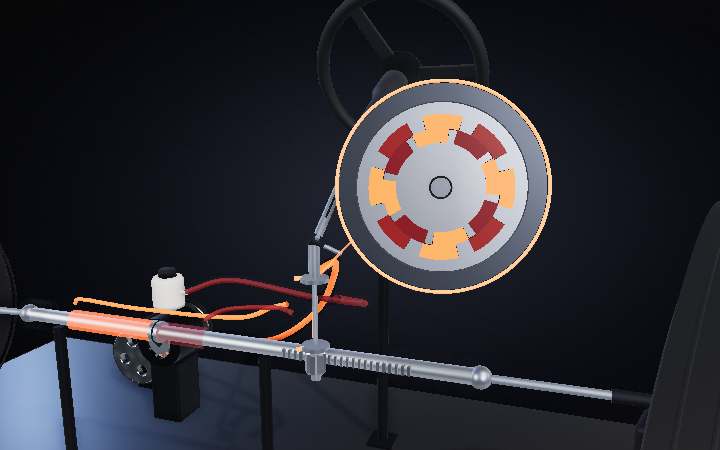
Whenever the engine runs, so does the pump. A slotted rotor spins inside an oval cam ring, and ten vanes slide out against the ring, gathering oil where the gaps widen and squeezing it out where they close. With the wheel centred the oil does no work. It runs straight through the valve and back to the reservoir at a few bar. The pump is always working; the valve decides where that work goes.
Step 04 of 07
Your wheel isn’t bolted to the pinion
The shaft from your steering wheel does not grip the pinion. The only thing joining them is a torsion bar, a steel rod about as thick as a pencil. Push on the wheel and the bar winds up before the pinion follows, and the two orange marks drift apart; ease off and it springs back. At full assist the twist is about 3.5°, drawn here four times larger so the stripe can be seen winding.
Step 05 of 07
The twist is the valve
Around the torsion bar sits the valve. The inner spool turns with your wheel, and the sleeve around it turns with the pinion. Both are cut with eight grooves. Centred, every sleeve groove is open a little to pump pressure and a little to return, so nothing pushes. Twist a few degrees and the spool’s edges slide across: grooves on one side seal off from return and fill with pressure, while the others open wide to return. Steer the other way and the pattern flips.
Step 06 of 07
Seven hundred kilos, on request
The pressure goes to a cylinder built into the rack housing, where a piston is fixed to the rack. About 100 bar on that piston is some 700 kg of push, enough to drag both tyres across the ground. As the rack moves it turns the pinion after your hands, so the twist unwinds and the valve closes again. Hold the wheel still and the assist settles to whatever the tyres push back with. It follows you and never takes over.
Step 07 of 07
Run it
Back together and running faster. Your hands twist a rod a few degrees, the twist meters oil, the oil moves the rack, and the rack unwinds the twist. If the engine stalls the pump stops with it, and the torsion bar winds up to a mechanical stop and turns the pinion directly. You can still steer, just heavily. You never turned the wheels. You twisted a rod.