How a Projector Works
One blinding lamp, a colour wheel spinning at 10,000 rpm, and a chip covered in two million hinged mirrors — how a DLP projector paints a wall-sized picture out of light it mostly throws away.
Step 01 of 08
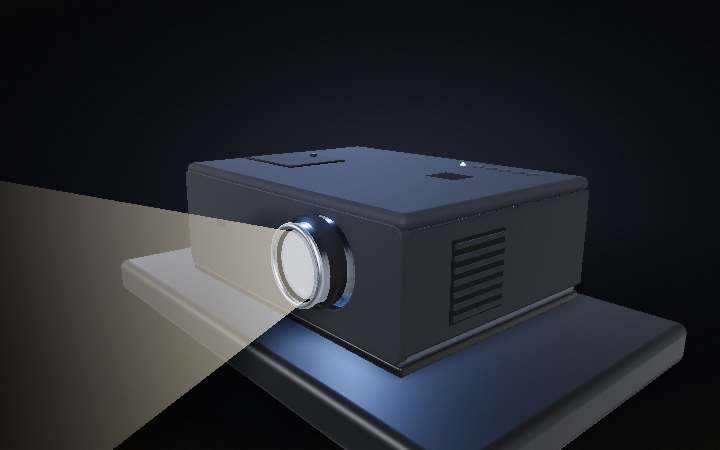
A box that throws a picture across a room
It sits on a shelf, hums, gets hot, and puts a two-metre image on your wall. Inside there is no screen and no picture — just a very bright lamp, a spinning disc of coloured glass, and one chip that decides, thousands of times a second, which light gets out through the lens and which light gets thrown away.
Step 02 of 08
Lift the lid
Everything inside is arranged along one folded line of light. It starts at the lamp on the left, runs the width of the case through a glass rod and a spinning colour wheel, bounces off a small mirror, and climbs to a chip the size of a postage stamp at the back. Whatever that chip sends forward goes out through the lens. Whatever it does not goes into a black block and becomes heat.
Step 03 of 08
The lamp is a controlled lightning strike
Inside that quartz capsule, an electric arc jumps a gap about a millimetre wide through mercury vapour under enormous pressure. It runs at a few thousand degrees and is far too small and far too blotchy to project directly. The reflector behind it scoops that light forward, and the glass rod after it bounces the beam off its own polished walls until the hot spot is smeared into an even rectangle.
Step 04 of 08
Colour arrives one at a time
This disc is not a filter wheel in the photographic sense — each wedge is a dichroic coating that lets one band of light straight through and reflects the rest away. It spins somewhere between 7,200 and 14,400 rpm, two to four times the speed of the video frames. Downstream of it the beam is never white again. It is red, then green, then blue, then red again, thousands of times every second.
Step 05 of 08
Two million mirrors on one chip
This is the DMD, blown up until you can see it. Each square is a single aluminium mirror a fifth the width of a human hair, and there is exactly one of them per pixel on your wall — about two million on a 1080p chip. Each one is slung on a torsion hinge running corner to corner, over its own memory cell in the silicon underneath. The cell holds one bit. That bit is the entire instruction.
Step 06 of 08
Twelve degrees, and nothing in between
A mirror has two positions and no others: tilted −12°, or tilted +12°. The lamp is aimed 24° off the chip, which is exactly twice the tilt — so a mirror at −12° kicks its light straight down the projection lens, and a mirror at +12° throws it 48° sideways into a black finned block that swallows it. That is a bright pixel and a dark pixel. Grey comes from speed: flip the mirror on and off thousands of times inside a single colour flash, and the fraction of time it spent aimed at the lens is the brightness you see.
Step 07 of 08
Your eye does the mixing
Now put the two halves together. While the red wedge is in the beam, the mirrors are drawing only the red part of the picture. A blink later the green wedge arrives and the same mirrors redraw the green part, then the blue. The chip never once shows a full-colour image — it shows three single-colour ones in a row, too fast to separate, and your eye adds them up. Glance quickly across the screen and the fusion breaks for a moment: that flash of red-green-blue fringing is this mechanism showing through.
Step 08 of 08
Run it
Lamp burning, wheel spinning, two million mirrors slamming between two stops faster than any moving part in your house. At any instant the picture on your wall is a single colour, and a large share of the light the lamp made is being deliberately thrown into a black block to make the dark parts dark. A projector spends a great deal of its energy on the pixels you are not meant to see.