How a Quartz Watch Works
A sliver of sand humming 32,768 times a second, counted down by fifteen switches, kicking a motor half a turn — how the cheapest watch in the drawer keeps better time than the most expensive one.
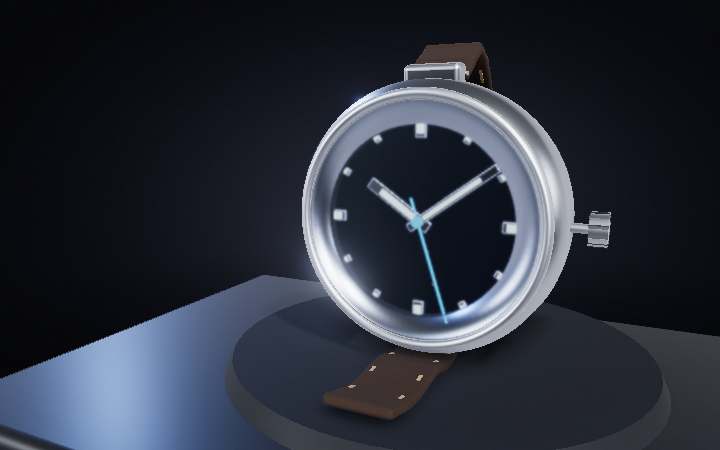
Step 01 of 07
1 · One jump a second
Look at the seconds hand. It doesn't sweep — it jumps, holds, jumps again, once a second, and it has done that every second since the battery went in. A mechanical watch hides a swinging balance wheel behind that motion. This one hides a sliver of sand.
Step 02 of 07
2 · Everything that keeps the time
Undo the back and the whole works lifts out on a single plate of ivory plastic. There is almost nothing on it: a battery the size of a lentil, a black speck of a chip, a coil of copper finer than hair, and a silver capsule two millimetres across. Only one of those knows what a second is, and it is the capsule.
Step 03 of 07
3 · A tuning fork cut from sand
Inside the capsule, sealed in vacuum, is a tuning fork about as long as a grain of rice, cut from a single crystal of quartz. Quartz is piezoelectric both ways: squeeze it and it makes a voltage, feed it a voltage and it bends. So the chip taps it, the fork rings, the ringing makes its own voltage, and the chip taps again in time — locking onto the one frequency the fork was ground to. 32,768 vibrations a second, every second, held to a few parts in a million.
Step 04 of 07
4 · Counting down to one
32,768 isn't a random number: it is two multiplied by itself fifteen times. Inside the chip sit fifteen switches in a row, each one flipping only when the switch above it has flipped twice — so every rung of this ladder runs at exactly half the speed of the rung above it. The top is a blur. Fifteen halvings down, the bottom rung flashes once, and that flash is the second.
Step 05 of 07
5 · The kick
The flash goes to the coil, and for a few thousandths of a second the coil becomes a magnet. Facing it, in a slot in the steel yoke, sits a permanent magnet a millimetre and a half across — and that slot is bitten off-centre, which is the only thing deciding which way the magnet swings. It flips half a turn and stops. The next pulse arrives with the current running backwards and flips it another half turn, the same way round; then the coil goes quiet for the rest of the second, which is why the battery lasts years.
Step 06 of 07
6 · Half turns into hands
Half a turn a second is far too fast for a seconds hand, so it goes through gears — but this train slows things down, where a mechanical watch's gears speed the mainspring up. Ten teeth drive sixty, then twelve drive sixty: thirty to one. Half a turn at the rotor comes out as six degrees at the centre of the dial, which is exactly one second on the face.
Step 07 of 07
7 · Fifteen seconds a month
Put it back together and nothing on the outside admits any of that. An ordinary quartz watch keeps time to about fifteen seconds a month; a fine mechanical one can lose that much in a day. One crystal, one chip, one coil — and it will do this about thirty million times a year until the battery gives up.