How Downforce Works
An aeroplane built to fly into the ground: upside-down wings, and a floor that turns the road into one wall of a tunnel and sucks the car onto the track.
Step 01 of 07
Grip you can buy with air
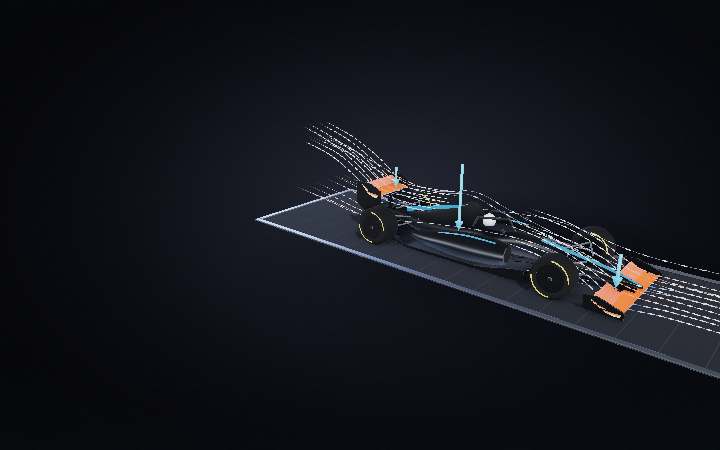
A tyre grips in proportion to how hard it is pressed into the road. A heavier car would grip harder, but it would also have more mass to brake, turn and accelerate, so the extra grip buys nothing. A race car gets the push without the mass. It uses the air rushing over it to press itself into the track. This one sits on a wind-tunnel rolling road: the car stays still while the belt and the air go past it.
Step 02 of 07
1 · Twice the speed, four times the push
Downforce grows with the square of speed. Watch the smoke speed up and the blue arrow grow: at 100 km/h the car makes about a quarter of its own weight, and at around 200 km/h it makes all of it. A 2020s Formula 1 car weighs about 800 kg with its driver, so above that speed the air presses it down harder than gravity does. On paper it could drive along a ceiling.
Step 03 of 07
2 · The front wing is an aircraft wing, upside down
Each element is shaped like a small aircraft wing mounted with its curved face toward the road. It turns the passing air upward, and turning air takes a push. Air piles up against the top face, so the pressure there rises (warm). Underneath, the air is squeezed between the wing and the road and speeds through, so the pressure drops (blue). More pressure on top than underneath adds up to a net push down on the nose.
Step 04 of 07
3 · The rear wing, and its off switch
The rear wing does the same job with two elements stacked steeply. A single surface this steep would stall, with the air peeling off its back. The slot between the two elements feeds fast air from underneath across the back of the flap and keeps the flow stuck to it. Downforce always costs drag, so on a straight the flap swings almost flat. The air stops being thrown upward, and downforce and drag both fall away.
Step 05 of 07
4 · The floor is the biggest wing on the car
Underneath, two tunnels run along the floor, and the road forms the bottom wall of each one. Air enters behind the front wheels and is squeezed through a narrow throat just above the track. It speeds up as it goes, and fast-moving air is at low pressure (blue). The atmosphere still presses on the whole top of the car at full strength, so the car is pushed down onto the road.
Step 06 of 07
5 · The diffuser pulls air through the tunnels
At the back, the tunnels sweep upward and widen into the diffuser. The air spreads out, slows down and is back at normal pressure by the time it leaves. Because the exit has to sit at normal pressure, that gentle expansion lets the throat run far below it, and more air is pulled through the tunnels than a flat floor could pass. Flare it too steeply and the flow tears away from the surface and the suction collapses.
Step 07 of 07
It grips harder the faster it goes
Put together, the front wing, the floor and the rear wing all press the car down, and on the 2022–25 cars more than half of it came from the floor. Downforce weighs nothing. It costs drag instead, and it grows with the square of speed, so a car that takes a corner twice as fast is pressed into the track four times as hard. It grips harder the faster it goes.