How a Rainbow Works
A rainbow is not an object and it is not in the sky — it is an angle, about 42 degrees, measured from the shadow of your own head. Every drop sprays the whole spectrum everywhere; you only ever catch one colour from any one drop.
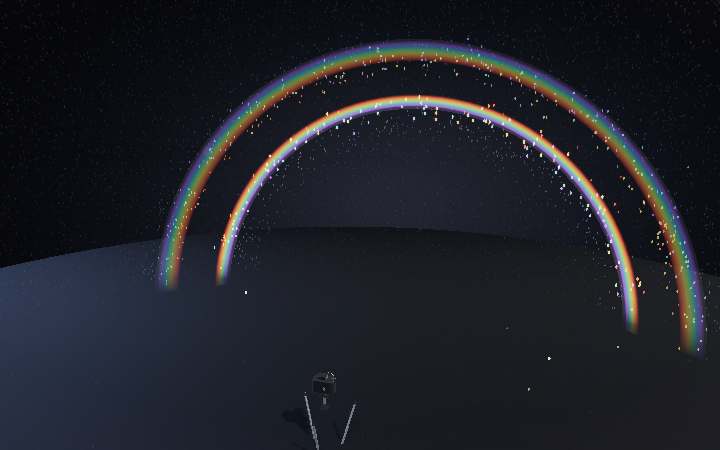
Step 01 of 09
Nothing is up there
A low sun behind you, a few million falling drops in front of you, and this appears. It has no position — you cannot walk to it, drive under it or photograph it from the side, because there is no it. What you are looking at is a direction: the set of drops that happen to sit at one particular angle from the back of your own head. Everything after this is that angle, taken apart.
Step 02 of 09
One drop, three events
Blow one raindrop up about two thousand times and the whole mechanism fits in a single frame. Sunlight bends as it crosses into the water, because light travels slower in water than in air. It crosses the drop, hits the back wall, and most of it leaves — but a slice bounces off the inside of that wall and comes back. Crossing out, it bends a second time. Two bends and one bounce. That is the entire machine.
Step 03 of 09
Why there is a bow at all
Sunlight does not arrive in one neat ray. It hits every part of the drop face, and each entry point comes back out at its own angle — so why is the sky not just evenly lit? Watch where the exits land. They do not spread out evenly; they crowd against a hard limit and stop. Rays that enter a long way apart come back within a fraction of a degree of each other, and that pile-up is the bright band. Beyond the limit, nothing comes back at all.
Step 04 of 09
One per cent of difference
Water bends violet light slightly harder than red: an index of 1.343 against 1.331, a difference of about one per cent. That one per cent gives every colour its own limiting angle — red piles up at 42.4°, violet at 40.7° — and the 1.7° between them is the entire width of a rainbow. It also means a single drop can only ever send you ONE colour. The red you see and the violet you see are coming from different drops, metres apart.
Step 05 of 09
An angle, spun around
Now put that angle back in the sky. Draw a line from the sun, through your head, and out the other side — it points at a spot called the antisolar point, always exactly opposite the sun, and on a sunny day your own shadow is standing on it. Any drop lying 42° off that line sends you colour. Spin 42° all the way around the line and you sweep out a cone with your eye at the tip. The bow is a circle because a cone is; you only see an arc because the ground cuts the bottom off.
Step 06 of 09
Your rainbow, not anyone else’s
The drops are pouring straight down through the band, and they do not stay any colour for long: a drop is red for an instant, then orange, then green, then it has fallen out of the angle and gone dark. The band itself never moves, because it was never made of those drops — it is made of the angle. Step forward and the whole cone steps with you, built out of drops that were dark a second ago. Your left eye and your right eye are not even using the same water.
Step 07 of 09
The one that bounced twice
Go back inside the drop. At the back wall, most of the light leaves and a slice bounces — and at the second wall, the same thing happens again. A thinner slice bounces a second time before it finally escapes. Two bounces send it out at a wider angle and in the opposite order, and far less of it survives the extra trip. This is a much rarer path than the one you just watched, which is exactly why the bow it makes is the faint one.
Step 08 of 09
And the sky it leaves dark
Put that path back in the sky and you get the second bow: 50° for red, nearly 54° for violet, sitting outside the first with its spectrum reversed — red on the inside now. Then look between the two. That stripe of sky is visibly darker than the sky on either side, and it has to be: no drop anywhere can return light into the gap between 42° and 50°. It is the one part of a rainbow that is made of nothing, and it has been called Alexander’s dark band since about 200 AD.
Step 09 of 09
Then the sun gets too high
The cone points away from the sun, so the higher the sun climbs, the further the cone tips into the ground — and once the sun passes 42°, the whole thing is underground and there is nothing left above the horizon to see. That is why rainbows are a morning and evening animal, and why you will wait a long time for one at noon in the tropics. It was never in the sky. It was aimed at you, and you just walked out of it.