How a Refrigerator Works
It doesn't make cold — it pumps heat out. Follow one charge of refrigerant from the humming compressor, up the warm coils on the back, through a hair-thin choke, and into the freezer where it drinks the heat out of your food.
Step 01 of 07
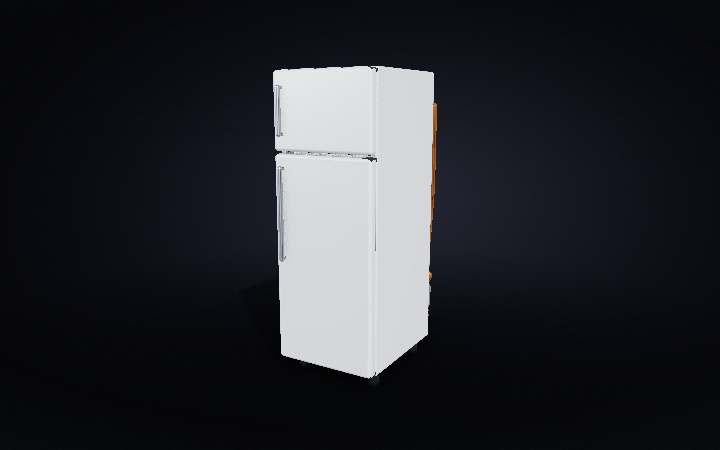
The refrigerator
The most reliable machine in your home: a steel box that hums a few times an hour and keeps food cold for twenty years. Here is its secret — it doesn't make cold at all. Cold isn't a thing you can make; it's just the absence of heat. A refrigerator is a heat pump: it grabs heat from inside the box and throws it into your kitchen. Let's open it up and watch it work.
Step 02 of 07
Inside the box
Doors off, shell to glass. One sealed loop of copper tube threads through the whole machine, charged with a refrigerant that boils at −26 °C. Four stations sit on the loop: a compressor humming in the bottom recess, the black grid of condenser coils on the back, a hair-thin capillary tube, and a finned evaporator hidden behind the freezer wall. The refrigerant laps the circuit and carries heat with it — always inward to outward.
Step 03 of 07
1 · The compressor
That hum when the fridge 'switches on' is this: a black hermetic dome in the bottom recess, a piston pump and its motor sealed inside with the refrigerant. It squeezes cool low-pressure vapour into hot high-pressure vapour — hotter than your kitchen. That matters, because heat only ever flows from hot to cold: to dump heat into the room, the refrigerant first has to be made hotter than the room.
Step 04 of 07
2 · The condenser
The hot vapour rises up the back and snakes down through the black grid you've felt behind every fridge — tube weaving through wire fins. Warmer than the kitchen air, it sheds its heat by simple convection (no fan needed; that's why the back of a fridge is always warm) and condenses into a warm high-pressure liquid. A small filter drier at the bottom strains out moisture and grit.
Step 05 of 07
3 · The capillary tube
Now the trick. The warm liquid is forced through several metres of tube barely wider than a hair, coiled up near the compressor. Fighting through costs it nearly all its pressure — and a liquid that suddenly loses pressure boils, and boiling drinks in heat. Part of it flashes to vapour instantly, chilling the whole stream to around −25 °C before it re-enters the cabinet.
Step 06 of 07
4 · The evaporator
The icy mixture weaves up through the finned evaporator hidden behind the freezer wall. Being far colder than the food, it soaks up heat and boils fully back into a gas, while a small fan washes the chilled air down through the freezer and fridge shelves. The gas then rides the fat suction line back down to the compressor, and the lap begins again. Your food never touches anything cold — it just keeps having its heat stolen.
Step 07 of 07
The cycle runs
Shell closed, the whole machine again. Compress, condense, choke, evaporate — the same few grams of refrigerant lapping the loop, pumping heat from the food to the kitchen a trickle at a time. A thermostat just switches the compressor on when the box drifts warm and off when it is cold enough. That gentle hum, a few times an hour, for twenty years — that is all a refrigerator ever does.