How a Resistor Works
A helix scratched through a hair-thin film of resistive material — how one spiral groove sets the exact resistance printed on the color bands.
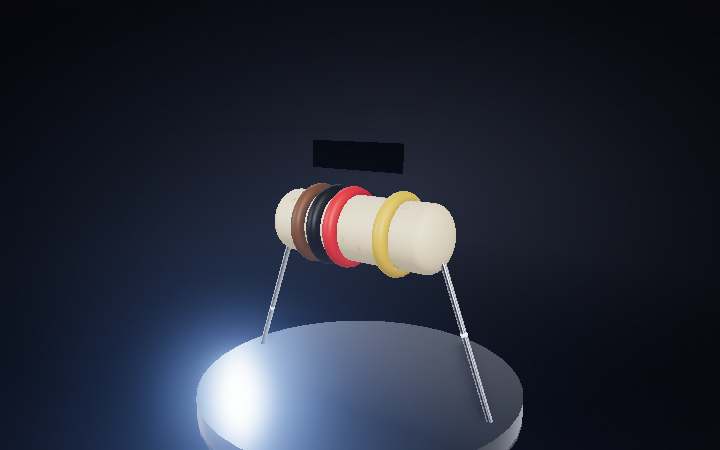
Step 01 of 06
1 · The component
This is a 1 kΩ fixed resistor — a tan ceramic rod with tinned leads, doing one job: throttling current in a predictable, fixed amount. It never stores energy like a capacitor and never switches like a transistor; it just resists, converting a precise fraction of the circuit's energy into heat every moment current flows through it.
Step 02 of 06
2 · Inside: film on a ceramic core
Peel the painted skin away and the resistor is a plain ceramic rod coated in a hair-thin resistive film — carbon or a metal alloy like nichrome. A helix is then cut straight through that coating, forcing current down one long, narrow spiral track instead of a short fat one. That cut groove IS the resistor: its length and width set the value.
Step 03 of 06
3 · Ohm's law: geometry sets R
R = ρL / A — resistance rises with the path's length and falls with its cross-sectional area. Cut a long, thin spiral (left) and the same voltage pushes only a trickle of current through; cut a short, thick one (right) and far more current gets through. Same ceramic, same film — the geometry of the cut alone is what separates a 10 Ω resistor from a 1 MΩ one.
Step 04 of 06
4 · Power becomes heat: P = I²R
Every electron that scatters off the resistive film while forcing its way down the spiral gives up a little energy — and that energy has nowhere to go but out as heat. Push more current through (P = I²R, not just IR) and the film glows hotter fast; this is exactly why power resistors are built big: more surface area to shed the same joules before the film overheats.
Step 05 of 06
5 · Reading the code: four bands
No multimeter needed — the four painted bands spell out the value directly. First two bands are significant digits, the third is a power-of-ten multiplier, the fourth is tolerance. Brown-Black-Red-Gold reads 1, 0, ×100, ±5%: (10) × 100 = 1000 Ω — a 1 kΩ resistor, guaranteed within 5% of that value.
Step 06 of 06
6 · Doing its job, quietly
Reassembled, this is the same unglamorous part scattered by the hundred across almost any circuit board — biasing a transistor, setting an LED's current, defining a filter's cutoff. No moving parts, no stored charge, nothing to wear out: just a fixed, dependable brake on current, warming a fraction of a degree and doing exactly what its four bands promise.