How a Rocket Engine Works
Burning the fuel is the easy part. The hard part is shoving three hundred kilos of propellant a second into a chamber already at ninety-seven atmospheres — which is why most of this engine is a pump, driven by a second, smaller rocket engine bolted to its side.
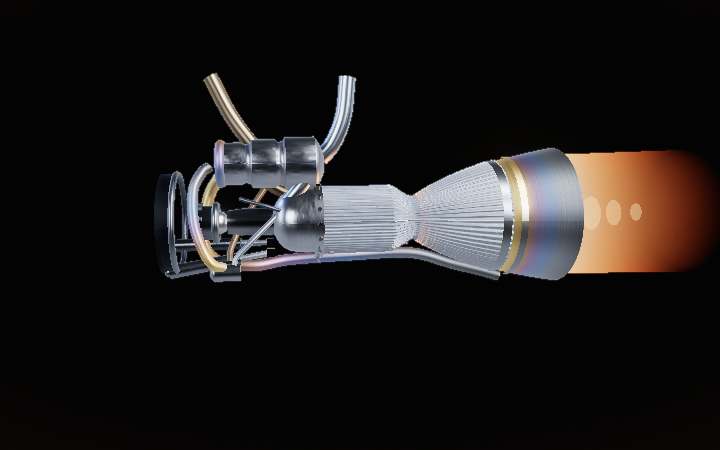
Step 01 of 09
Almost none of this is the fire
The burning happens in the ribbed silver drum in the middle. Everything else — the pump bolted above it, the little can tucked in behind, the pipe that runs the whole length of the bell and back — exists to get three hundred kilos of liquid a second into that drum. And the drum is already at ninety-seven atmospheres. That is the actual problem a rocket engine solves: not how to burn kerosene, which is easy, but how to keep shoving more of it into a space that is already the most violently pressurised place for a hundred miles.
Step 02 of 09
The tanks are at three bar. The chamber is at ninety-seven.
Liquid does not flow uphill, and pressure is the hill. You could build the tanks strong enough to push propellant in by themselves, and small rockets do exactly that — but tanks that hold ninety-seven bar are tanks with thick heavy walls, and the whole reason a rocket exists is to not carry heavy things. So the tanks stay thin and floppy at three bar, and a pump does the lifting instead: it takes propellant in at three bar and hands it over at about a hundred and fifty. Follow the amber line, though. The fuel does not go to the chamber. It goes all the way down the nozzle first.
Step 03 of 09
One shaft, thirty-six thousand rpm
Take the housing off and the pump is three wheels on a single shaft. Two of them are impellers — one for oxygen, one for kerosene — spinning fast enough that the liquid is flung outward and arrives at the rim with nowhere to go but out the discharge pipe at a hundred and fifty bar. Pumping is really just that: throw the liquid, then make it stop. The shaft turns at thirty-six thousand rpm, six hundred times a second, and the pump draws around ten thousand horsepower — more than a mainline locomotive — out of a package you could carry under one arm. Which raises the obvious question: what is turning it?
Step 04 of 09
It is spun by a second, smaller rocket engine
The can hanging underneath is a gas generator, and it is a complete little rocket engine in its own right — its own injector, its own combustion, burning about two per cent of everything the pump moves. What it is not is efficient, deliberately. It runs heavily fuel-rich, so there is far more kerosene than oxygen and the flame comes out sooty and merely warm — around six hundred degrees instead of the three thousand next door. A stoichiometric flame would shred the turbine blades in seconds. That warm gas spins the turbine, the turbine spins the pumps, and the pumps feed the gas generator: the engine bootstraps itself. Then the spent gas is simply thrown away down the side of the bell, which is why this cycle is called open, and why it gives up a few per cent of performance for a great deal of simplicity.
Step 05 of 09
Two sheets of liquid, hitting at right angles
Both propellants finally meet at the pintle — the chrome post sticking out of the injector face. Kerosene comes up the middle of the post and leaves through a ring of slots as a flat sheet flying straight outward. Oxygen comes down the gap around the post and leaves as a hollow tube of liquid flying forward. The two sheets collide at ninety degrees, and that collision is the entire atomiser: it shatters both into a mist fine enough to burn in the couple of thousandths of a second it has before it reaches the throat. What makes this design special is that it is one moving part instead of six hundred drilled holes — so you can turn it down to forty per cent thrust, shut it off, and light it again. That is what makes landing a booster possible.
Step 06 of 09
Then it squeezes through a hole
Inside the chamber the gas is at ninety-seven bar and about three thousand three hundred degrees — comfortably hot enough to boil steel, which melts at fifteen hundred and boils around two thousand nine hundred. It is also going almost nowhere: the chamber is wide, so the gas mills around. Then the wall closes in to that narrow waist, and at exactly the narrowest point the gas hits Mach 1 — never more, never less. That is not a coincidence, it is a law: a converging duct cannot push a gas past the speed of sound. And once the throat is at Mach 1 the flow is choked, which means the chamber can no longer be influenced by anything downstream of it. The engine stops caring whether it is at sea level or in vacuum. Everything from here on happens in a place the chamber cannot hear.
Step 07 of 09
Past the throat, wider means faster
Below the waist the bell flares out, and here the rule inverts: a supersonic gas speeds up as its duct widens. It trades pressure and heat for sheer velocity, and by the lip — sixteen times the throat area — it is doing about Mach three and a half and roughly two thousand nine hundred metres a second. That flare is not styling; it is most of the thrust. Now look at the amber packets on the wall, running the wrong way. That is the kerosene, and it has not been burned yet — it is pumped through channels milled into the wall from the far end of the bell forward to the injector before it is allowed anywhere near the flame. The propellant is the coolant. The heat it steals from the wall is not lost either; it goes into the chamber with the fuel. That is why this bell is thin metal and not ceramic, and why a rocket engine can run three thousand degrees against a wall you could machine on a lathe.
Step 08 of 09
Steering means moving the whole engine
A rocket has no air to push against, so there are no rudders and nothing to bank into. The only force that exists is the one coming out of the nozzle, which means the only way to steer is to point that force somewhere other than straight through the centre of mass. So the entire engine — pump, gas generator, plumbing, the lot — hangs on a single ball joint, and two hydraulic actuators shove it around by about five degrees. Five degrees is plenty. The engine is metres behind the centre of mass, so a small angle down there is a large torque up here, and a booster balancing on its own exhaust is really just this joint making tiny corrections, several times a second, all the way down.
Step 09 of 09
Run it
All of it at once. A can of sooty fire spins a turbine, the turbine drives two impellers to a hundred and fifty bar, the kerosene takes the long way through the walls of the bell to keep them from melting, two sheets of liquid collide on a chrome post, and a column of gas leaves the lip at nearly three kilometres a second. The engine feeds itself the whole time — every part of that chain is powered by the chain. And it will hold that going for something over two and a half minutes, which is all it needs: by then it is out of the thick air and most of the way to orbital speed.