How the Seasons Work
Earth is closest to the Sun in early January, in the middle of northern winter. The seasons come from a 23.4° lean that tips each half of the planet toward the Sun and then away, and the same lean steers the monsoon rains and the snow line.
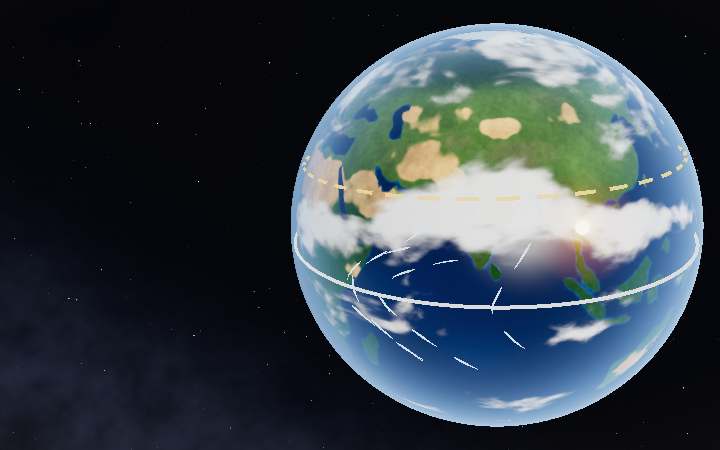
Step 01 of 09
1 · A year in thirty seconds
This is one year on Earth, squeezed into thirty seconds. Watch the top of the globe: a white cap of snow spreads south over Canada and Siberia, then shrinks back to Greenland. Watch the middle: a band of cloud drifts north over India and back again, and the land underneath turns green. All of it has one cause, and it is not the Sun coming closer. It is the tilt of the line the planet spins around.
Step 02 of 09
2 · Closest in January
Here is the orbit, seen from outside. It is very nearly a circle: over a year, Earth's distance from the Sun only swings between 147.1 and 152.1 million kilometres. The closest point comes on 3 January, in the middle of the northern winter. If distance made the seasons, the whole planet would have summer at the same time, in January. Instead the north freezes while Australia has its summer. Distance changes the sunlight by about 7 percent. The real cause is in the blue sticks around the orbit: every one points the same way.
Step 03 of 09
3 · A 23.4° lean
Now ride along with Earth, keeping the Sun fixed on the right. The axis is tilted 23.4°, and it keeps aiming at the same point in the sky, near the Pole Star, while Earth goes round. From here that makes the planet seem to nod. In June the north end leans into the sunlight. In December it leans away, and the south gets its turn. The gold dot is the one place where the Sun stands straight overhead at noon. Over the year it walks between the two dashed lines, the Tropics, and never goes past them.
Step 04 of 09
4 · The same sunlight, spread thin
Take one square of sunlight at noon and aim it at 45° north, the latitude of Milan or Minneapolis. In June the Sun stands 68° above the horizon and the beam lands on a tight patch. In December it climbs only 22°, the beam arrives at a slant, and the same light is spread over 2.5 times as much ground. Each square metre gets less of it. That is why winter sunshine feels thin on your face, even at midday.
Step 05 of 09
5 · Long days, short days
The tilt does a second thing. On the 45° north circle, gold is daytime and blue is night. In June the circle is mostly gold: 15 hours 26 minutes of daylight. In December it is mostly blue, 8 hours 34 minutes. Steeper Sun and longer days together mean a square metre at 45° north takes in about four times as much sunlight on a June day as on a December one. Further north it gets extreme. The Arctic Circle is all gold in June and all blue in December: one day the Sun never sets, and six months later it never rises.
Step 06 of 09
6 · Spring and autumn are the crossings
Twice a year, around 20 March and 22 September, the axis leans neither toward the Sun nor away from it, only sideways. The line between day and night then runs through both poles and cuts every circle of latitude exactly in half. Everywhere on Earth gets 12 hours of day and 12 of night. That is what "equinox" means. The overhead Sun crosses the equator, heading north in March and south in September. Spring and autumn are the weeks around these crossings, when the days lengthen or shorten fastest.
Step 07 of 09
7 · The monsoon follows the Sun
In the tropics the Sun is always high, so the seasons that matter are wet and dry. Here is South Asia, held still while the year runs. In May the overhead Sun reaches India. Land heats far faster than the sea, and the hot air over it rises. The belt of rain clouds that circles the tropics follows the heat north, and moist sea air pours in to replace the rising air. Trade winds from south of the equator cross it, Earth's spin bends them into south-westerlies, and they arrive soaked. The rains reach Kerala around 1 June and cover the whole country by early July. June to September brings three quarters of India's rain for the year. In autumn the Sun moves south and the winds reverse, blowing dry off the land.
Step 08 of 09
8 · Snow is a long night
Now the top of the world. In December the Sun never rises north of the Arctic Circle, and across the northern continents the days are short and the Sun stays low. Land loses heat into space every night. When the nights win, the air near the ground stays below freezing, and whatever falls from the clouds lands as snow. The snow line creeps south across Siberia and Canada until, by January, about 47 million square kilometres of the north is white. By August the summer Sun has cut that to about 3 million, most of it on Greenland's ice. Snow also reflects most of the sunlight that does arrive, which helps the cold hold on.
Step 09 of 09
9 · Not closer. Just leaning.
Put it all back together. Earth is not closer to the Sun in the northern summer. It is actually farther away. It just leans. The lean sets how high the Sun climbs and how long it stays up, and that one dial, turning slowly through the year, makes summer and winter, the equinoxes, the monsoon rains and the snow.