How a Gun Works
From a squeeze of the trigger to a sonic crack downrange: the spring, the primer, the spinning bullet, and the self-reloading action, all in about a tenth of a second.
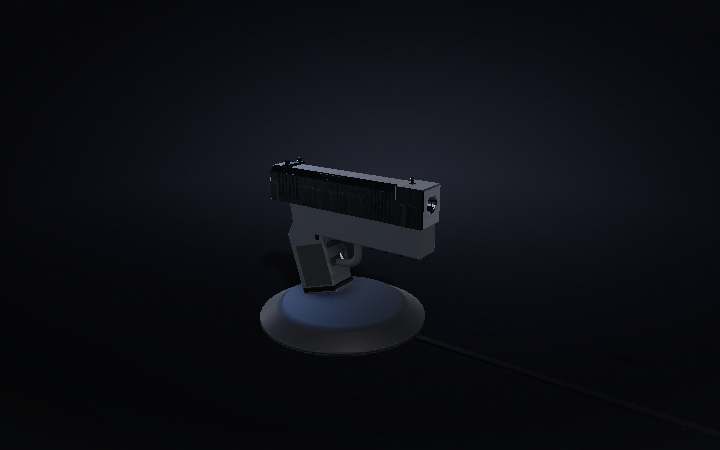
Step 01 of 09
The pistol
This is a modern semi-automatic pistol as you would actually hold it: a steel slide riding on a polymer frame, a grip that houses the magazine, a trigger, and sights. Nothing here looks like it is about to do very much — yet one squeeze sets off a chain of ten mechanical events that finishes before you can blink. Let us open it up.
Step 02 of 09
Inside the pistol
Now the shell turns to glass. Behind the breech sits a spring-loaded striker; ahead of it, the barrel and its chamber holding a single cartridge. A recoil spring runs under the barrel, a trigger bar links the trigger to the striker, and the grip is a stack of cartridges pushed up by a spring. Two machines share this frame: an ignition system, and a self-reloading action.
Step 03 of 09
1 · Pulling the trigger
Squeezing the trigger doesn't fire the gun directly — it drives a trigger bar that first draws the spring-loaded striker back those last couple of millimetres, then tips a small sear out of its notch. The instant the sear lets go, the trigger's job is finished. Everything from here happens on its own.
Step 04 of 09
2 · Primer to powder
Freed from the sear, the striker snaps forward under its own spring and drives its firing pin into the primer — a dab of shock-sensitive compound in the base of the case. The primer flashes through a tiny hole and ignites the powder charge behind the bullet. It isn't so much an explosion as an extremely fast, contained fire: pressure inside the sealed case spikes to roughly 35,000 psi (240 MPa) in a couple of milliseconds.
Step 05 of 09
3 · Down the barrel
That pressure has one way out: forward, against the base of the bullet. Rifling grooves cut into the bore bite into its jacket and force it to spin as it accelerates. About a millisecond and 4 inches later, it leaves the muzzle already spinning at somewhere around 1,500 turns a second — several times faster than a Formula 1 engine screaming at redline. That spin is a gyroscope: it is what keeps the bullet flying straight, nose-first, for the rest of its flight.
Step 06 of 09
4 · Cycling the action
The same gas pressure that launches the bullet also shoves the slide and barrel backward together. After a few millimetres the barrel tips down and stops, unlocking from the slide; the slide keeps travelling alone, its extractor dragging the spent case out of the chamber until a fixed ejector post flips it clear through the ejection port. A recoil spring then snaps the slide forward again, stripping a fresh cartridge off the magazine on the way through — the pistol reloads itself in well under a tenth of a second.
Step 07 of 09
5 · Bullet in flight
Once it clears the muzzle, the bullet is on its own: no more propellant gas, just momentum, gravity, and air drag fighting it every metre of the way. Because it left the barrel faster than sound, it drags its own miniature sonic boom behind it — a sharp crack that outruns the gun's bang and reaches a listener downrange first. Drag bleeds off its speed continuously, and gravity pulls it into a curving arc it can never climb back out of.
Step 08 of 09
6 · How fast is that, really?
“Faster than sound” is abstract until you race it. Here are six things moving at their real speeds, for the same slice of time: a sprinting cheetah at 29 m/s, a Formula 1 car at 97 m/s, a cruising airliner at 260 m/s. Sound itself covers 343 m/s — and this pistol's bullet is already ahead of it at about 375 m/s. Hand the same powder charge a slimmer, faster rifle cartridge and it can more than double that again.
Step 09 of 09
Run it
Shell closed, the finished pistol again: trigger, sear, striker, primer, powder, rifling, recoil, extraction, ejection, reload — ten mechanical events, chained together, finished before the sound of the shot reaches your ear. All of it off a single squeeze of the finger, once per pull, every time.