How a Sewing Machine Works
Two threads that never touch until they meet inside the cloth — and a steel hook that has to catch a loop of thread in a gap a tenth of a millimetre wide, a thousand times a minute.
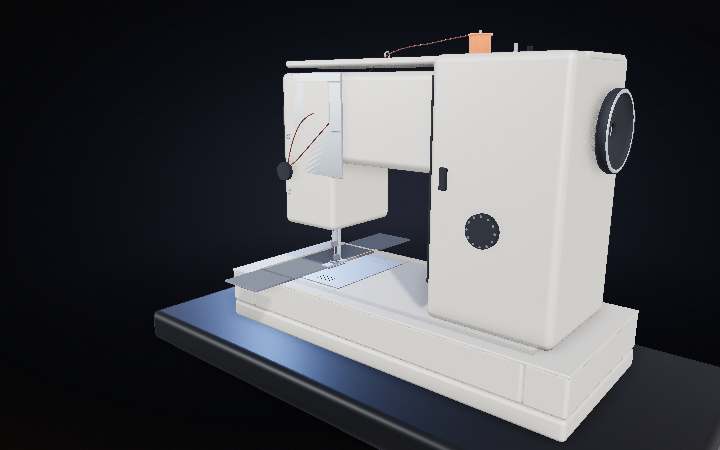
Step 01 of 09
A knot, a thousand times a minute
Every stitch this machine makes is a knot. Not a loop pulled through a loop like knitting — a real interlock between two separate threads, tied inside the cloth, about a thousand times a minute. From out here you can see maybe a fifth of the machine that does it: a needle, a foot, a wheel. Everything else is under the cream casting, and almost all of it exists to keep two moving parts within a tenth of a millimetre of each other.
Step 02 of 09
Two threads that never meet
There are two threads in here and they live in separate worlds. The top one comes off the spool, down through a pair of tension discs, up over the take-up lever and into the needle. The bottom one is wound on a bobbin sitting under the needle plate. Here is the part almost nobody realises: the bobbin thread never passes through the cloth. Not once. It lies underneath, and the top thread has to come down and lasso it.
Step 03 of 09
The eye is at the point
The eye of a sewing needle is at the sharp end. That one idea is the entire machine — put the eye at the blunt end, the way a hand needle has it, and there is no way to get the thread back out of the fabric. Watch the bottom of the stroke: the needle reaches the bottom, then rises about two millimetres. Friction in the cloth holds the thread back, and a small loop bulges out behind the needle, against the flat scooped into its back — the scarf.
Step 04 of 09
A tenth of a millimetre
That loop exists for about a hundredth of a second, and this is what it is for. A hardened steel beak on the rotating hook swings round, passes the needle closer than the thickness of a sheet of paper, and slides straight through the middle of it. Arrive two degrees late and the loop has already collapsed — that is a skipped stitch. It is the tightest tolerance in the machine and it has to be hit on every single stroke.
Step 05 of 09
All the way around the bobbin
Now the hook drags the loop right around the outside of the bobbin case. One side of the loop slides over the top, the other under the bottom, and they meet again on the far side — which means the loop has just been passed completely around the bobbin, and the bobbin thread is threaded through it. The case itself never turns: a small finger holds it still while the hook spins around it, leaving a gap under a millimetre wide for the thread to slip through.
Step 06 of 09
The lever that ties it
The loop slips off the hook and leaves a long tail of slack thread under the cloth. Getting rid of that slack is the take-up lever's only job. It swings up and hauls the thread back, dragging the knot up off the bobbin and into the fabric. Where the knot stops is settled by a tug-of-war: the tension discs pulling from above against a little leaf spring on the bobbin case below. Balanced right, it stops halfway through the cloth, invisible from either side.
Step 07 of 09
Nothing has moved the cloth yet
Under the plate, two toothed bars ride an oval track: up through the slots, back by exactly one stitch length, down, then forward again underneath. They only grip while they are up, and they are only up while the needle is clear of the cloth — a window of about 120 degrees of shaft rotation, with three degrees to spare at each end. The presser foot pins the cloth down onto them so it cannot slide. This one is set to 4.5 mm, the longest stitch it has, so you can see it move.
Step 08 of 09
One shaft decides everything
There is one motor and one arm shaft, and no part of this machine decides anything for itself. The shaft throws the needle bar and swings the take-up lever. A belt carries the same rotation down to a lower shaft, which rides the feed cams — and then a pair of bevel gears doubles it, because the hook has to turn exactly twice for every one stroke of the needle. Two to one, forever. Slip a single tooth and the beak arrives at the wrong moment, and the machine simply stops sewing.
Step 09 of 09
One stitch, eleven milliseconds
Needle down. Needle up two millimetres. Beak through the loop, around the bobbin, cast off, take-up snaps it tight, dogs carry the cloth back one notch. That is one stitch. A domestic machine does it around a thousand times a minute; an industrial head gets through five and a half thousand — one complete knot every eleven milliseconds. Everything you are wearing is held together by some version of this.