How a Smartwatch Measures Your Heart Rate
Your watch never hears your heart. It shines green light into your wrist, watches it come back a fraction darker each time a beat pushes blood under the sensor, and counts the dips.
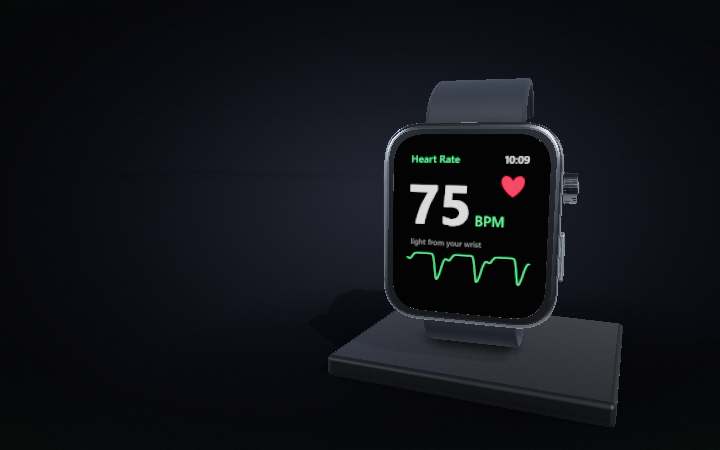
Step 01 of 07
1 · A pulse with nothing touching an artery
This watch says 75 beats per minute. It has no microphone listening for your heart, and nothing presses on an artery the way a nurse's fingers do. All it has is a small glass dome on its back, resting on your skin. Everything happens there, with light.
Step 02 of 07
2 · Green lights and dark windows
Turn it over and look through the back crystal. In the middle sit the LEDs, and the green ones do the heart-rate work. Around them are four photodiodes, dark squares that turn light into a tiny electric current. Black walls between them stop LED light leaking straight across. While it measures, the LEDs flash hundreds of times a second. That is the green flicker you see on your wrist in the dark.
Step 03 of 07
3 · Light goes in, a little comes back
Here is a magnified slice of the sensor resting on skin. Green light from the LED goes into the skin and scatters, and a small share of it curves back up to the photodiode a few millimetres away. On the way it passes capillaries and small arteries. Blood absorbs green light strongly, so light that runs into blood never comes back.
Step 04 of 07
4 · Each beat, a little darker
Every heartbeat sends a surge of blood that stretches the small arteries for a moment. Wider arteries swallow more green light, so a little less reaches the photodiode. Then they relax and the light comes back. The panel shows how small that change is. Almost all the light that returns is steady, from skin, tissue and veins. The beat is a flicker at the very top, about one percent or less.
Step 05 of 07
5 · Your arm is louder than your heart
Swing your arm and the watch shifts against your skin while blood sloshes around your wrist. That changes the light far more than your pulse does. So the watch carries an accelerometer, a chip that feels every movement. The screen shows the raw light, the motion the accelerometer measured, and what is left once the watch filters that motion out: your pulse.
Step 06 of 07
6 · Counting the dark moments
Now there is a clean wave with one dip for every heartbeat. The watch times the gap from one dip to the next. Here it is 0.80 seconds, and 60 seconds divided by 0.80 is 75 beats per minute. A real watch looks at several seconds of signal at once, which is why a new reading takes a moment to settle.
Step 07 of 07
7 · Run it
Light goes in, blood swallows a little more of it on every beat, and the watch counts the dark moments. It does this all day without a needle or a microphone. When the signal is weak, on a cold wrist or under a loose strap, it turns the LEDs brighter and samples faster. Some watches also use infrared, a colour you cannot see, for readings in the background.