How a Soap Pump Works
Pressing the pump does not pull soap up — letting go does. A spring, a piston and two glass balls that only let soap go one way.
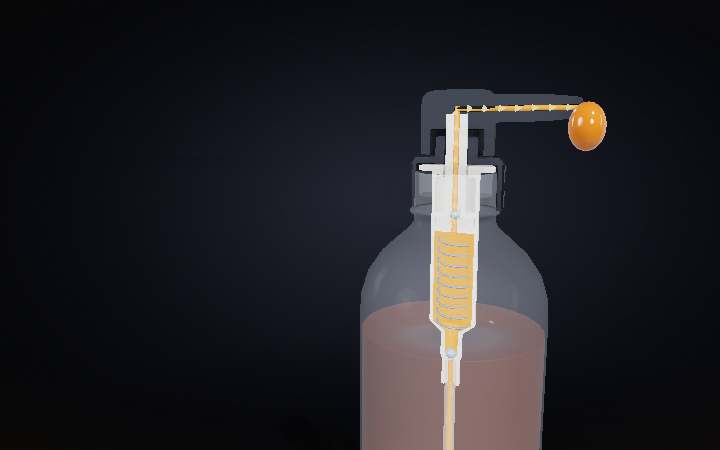
Step 01 of 06
1 · Press, and out it comes
Press the head of a soap pump and about 2 mL lands in your hand, the same amount every time. There is no motor and no battery, only a plastic head screwed onto a bottle. What is odd is where that dose comes from. Your press does not pull it out of the bottle.
Step 02 of 06
2 · A tiny piston pump
Cut the pump in half and you find a small piston pump. A plastic cylinder hangs from the cap down into the soap. Inside it, a piston rides on a hollow stem that leads up to the nozzle. A steel spring underneath pushes the piston up, and a thin straw, the dip tube, reaches to the bottom of the bottle. In this design the only valves are two glass balls, each smaller than a peppercorn.
Step 03 of 06
3 · Letting go fills it
Watch the bottom ball as the piston rises. The spring pushes it up, the space under it grows, and the pressure inside drops. Air, let in through a pinhole vent under the cap, presses down on the soap in the bottle and now pushes harder than anything in the chamber, so it drives the soap up the dip tube, lifts the lower ball off its seat and fills the chamber. The upper ball stays shut, so nothing is drawn back in from the nozzle.
Step 04 of 06
4 · Pressing empties it
Now press. The piston drives down, and the soap under it has to go somewhere. It slams the lower ball onto its seat, which closes the way back to the bottle. The only way out is up through the piston: the soap lifts the upper ball, runs up the hollow stem and leaves through the nozzle. Every dose you get was drawn in on your last release. The press only pushes it out.
Step 05 of 06
5 · Why a new pump spits air
A new pump is full of air, and air squashes. Pressing only compresses it and puffs a little out of the nozzle. Letting go draws the soap just part of the way up. Each stroke lifts the column higher: up the dip tube, past the lower ball, into the chamber. Once the chamber holds liquid, which does not squash, the next press pushes soap out. Here it takes five presses; real pumps usually need three to six.
Step 06 of 06
6 · Press, release, press
Each press shuts the lower ball and sends a dose out of the nozzle. Each release shuts the upper ball while the spring draws the next dose up. That is about 2 mL a stroke, from a 14.5 mm piston moving 12 mm. You press. The spring does the pulling.