How a Solar Panel Works
Photons that left the sun's core 100,000 years ago and crossed 150 million km of space strike a silicon wafer and knock electrons loose — a buried junction sweeps them into a current, sixty cells wired in series turning sunlight into usable DC.
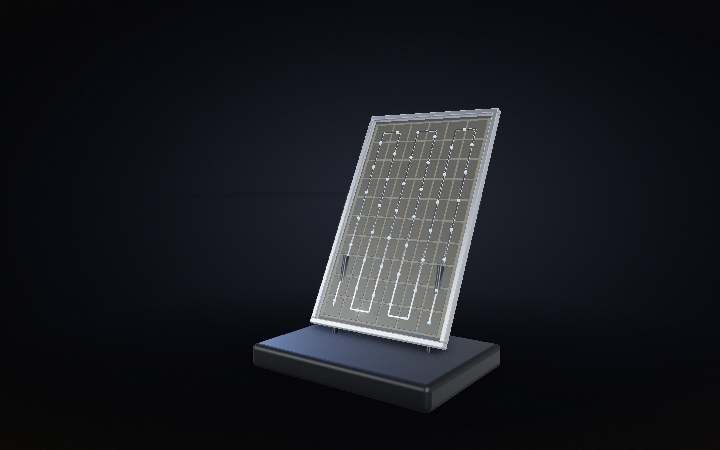
Step 01 of 07
1 · A sealed module
Sixty silicon cells, laminated glass to backsheet, framed in anodized aluminum and racked at the angle your roof gets the most sun. From the outside it's inert — nothing here spins or burns. Everything that happens, happens to electrons.
Step 02 of 07
2 · Where the light comes from
The rack tilts the module to face the sun straight on. In its core, hydrogen fuses into helium at about 15,000,000°C. That energy takes roughly 100,000 years just to random-walk out through the sun's own bulk — then, once it leaves the surface as light, only about 8 minutes to cross 150 million km of space. Only photons energetic enough to clear silicon's 1.1eV bandgap can do anything once they land.
Step 03 of 07
3 · Five layers, pulled apart
Glass on top, a black polymer backsheet on the bottom, and the cells themselves sandwiched between two sheets of EVA plastic that get heated until they fuse everything into one waterproof laminate — about 4.5mm thick, sitting inside a much deeper aluminum frame.
Step 04 of 07
4 · One cell, up close
A thick base of p-type silicon carries a wafer-thin n-type skin diffused onto its face — the junction between them. When a photon frees an electron there, the junction's own built-in electric field sweeps that electron toward the front contact and pushes its paired hole the other way. That separation IS the electricity.
Step 05 of 07
5 · Sixty cells, one string
Each cell only makes about half a volt. Silver ribbons solder the front of every cell to the back of the next, wiring all sixty in series so their voltages stack — roughly 36V DC by the time current reaches the edge of the module.
Step 06 of 07
6 · Off to the wiring
The string is split into three 20-cell groups, each guarded by its own bypass diode — if one section is shaded, current routes around it instead of stalling the whole module. Two DC leads carry the current out of the junction box, on to an inverter.
Step 07 of 07
7 · Sunlight in, current out
Sealed back up and facing the sky, the whole module runs on nothing but this: photons landing, electrons freed, a junction sorting them into a current. No moving parts, no fuel — just silicon doing what silicon does in the light, enough to light this bulb.