How the Solar System Works
Eight planets falling around a star, and never landing. Every orbit is an ellipse with the Sun off to one side — and the Sun is not standing still either: it circles a point just outside its own surface while the whole system flies through the galaxy at 230 km a second.
Step 01 of 09
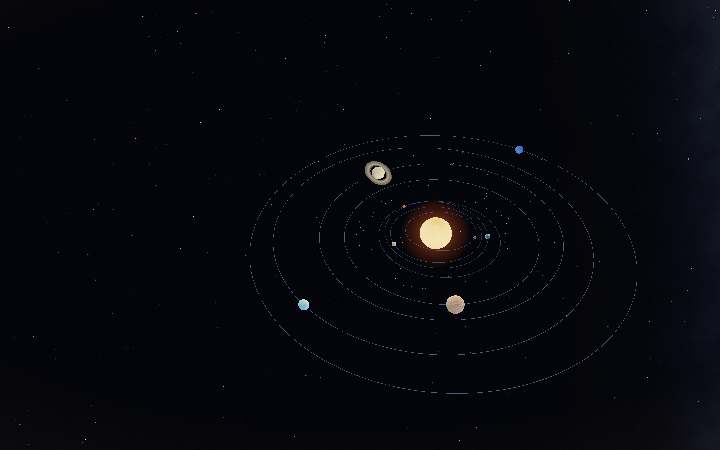
1 · Eight things falling, and never landing
Nothing is holding these planets up. There is no rail, no engine, no invisible arm — each one is simply falling toward the Sun and missing, over and over, forever. What this picture cannot show you is how far apart they are. Draw the Sun a centimetre across and Earth becomes a speck of dust a metre away, while Neptune's orbit is a circle sixty-five metres wide. Distances here are compressed; the shapes, the tilts and the order are not.
Step 02 of 09
2 · An orbit is a miss, repeated
Gravity is the only force on Earth and it points straight at the Sun the whole way round, so why does Earth never arrive? Because it is also moving sideways at 30 kilometres a second. In one second it falls about three millimetres toward the Sun — and in that same second it travels far enough along that the Sun has curved away beneath it by roughly the same three millimetres. Take the sideways speed away and you get the grey body: a straight drop, no orbit, gone in 65 days.
Step 03 of 09
3 · The inner four are small, rocky and quick
One astronomical unit is the Earth–Sun distance: 149.6 million kilometres. All four rocky planets fit inside 1.6 of them, and being close in is exactly why they move so fast — Mercury runs at 48 kilometres a second and gets round in 88 days, the shortest year in the system. Venus takes 225 days, Earth 365, Mars 687. Past Mars the character of the place changes completely.
Step 04 of 09
4 · The outer four are enormous, and slow
Beyond the asteroid belt each giant sits roughly twice as far out as the one before, and the years stretch accordingly. Jupiter, at 5.2 AU, takes 11.9 of ours. Saturn takes 29. A single year on Uranus, 19.2 AU out, is longer than most human lives — 84 years. And Neptune, at 30 AU, has been round the Sun exactly once since it was found in 1846.
Step 05 of 09
5 · Every orbit is an ellipse, and the Sun is off to one side
An orbit is an ellipse, and the Sun does not sit at its centre — it sits at one focus, off to one side. Most of these are so nearly circular that you would never catch it by eye. Mercury gives it away: its orbit runs from 46 million kilometres out to 70 million, and its speed swings with it, 59 kilometres a second at the near end and 39 at the far end. The two wedges cover the same slice of time and enclose the same area — the whole of Kepler's second law, and the reason a planet has to hurry when it is close.
Step 06 of 09
6 · Further out is slower, twice over
An outer planet has a longer way to go, and it also travels that way more slowly: 48 kilometres a second for Mercury, 5.4 for Neptune. Kepler found the exact rule in 1619 — square the length of a planet's year and you get the cube of its distance, for every planet, with nothing else needed. Watch the inner ones lap the outer ones. One honest warning: the real spread is 685 to one, and at that ratio a single Neptune orbit would take you a quarter of an hour to sit through. The outer planets here are sped up. Only their order is exact.
Step 07 of 09
7 · Seen from the side, it nearly vanishes
Turn the system edge-on and it collapses into a line. Every planet orbits within a few degrees of the same plane — Mercury is the worst offender at 7 degrees, Mars sits at 1.9, Neptune at 1.8, and Earth defines zero by convention. That flatness is a fossil. The Sun and its planets condensed out of one collapsing cloud that was already turning, and a turning cloud flattens into a disk long before it makes anything solid. The planets did not settle into a plane; they were built inside one.
Step 08 of 09
8 · The Sun is orbiting something too
The Sun holds 99.86 percent of the mass here, which makes it nearly the fixed point — but only nearly. Jupiter pulls back on it, and the two of them circle their shared centre of mass. That point sits 742,000 kilometres from the Sun's centre: 1.07 solar radii, which puts it about 46,000 kilometres above the surface. So the Sun really does orbit a spot outside itself, once every 11.9 years, at about 12.5 metres a second. Small — and detectable. Watching other stars make that same little circle is how the first generation of exoplanets was found.
Step 09 of 09
9 · And the whole thing is going somewhere
None of this is standing still. The entire system is orbiting the centre of the galaxy at 230 kilometres a second, from 26,000 light years out, one lap every 230 million years — the Sun has been round roughly twenty times since it formed. Add that motion and no planet traces a closed loop: each one draws a helix, stretched out behind it. And it does not fly face-on, the way the popular animation shows it, with the planets trailing after the Sun like a comet's tail. The orbital plane is tipped about 60 degrees to the plane of the galaxy, so every planet spends half its year ahead of the Sun and half behind.