How a Table Fan Works
A motor, three tilted blades and one sneaky little crank — how a desk fan spins, pushes air, and sweeps the room.
Step 01 of 04
The anatomy
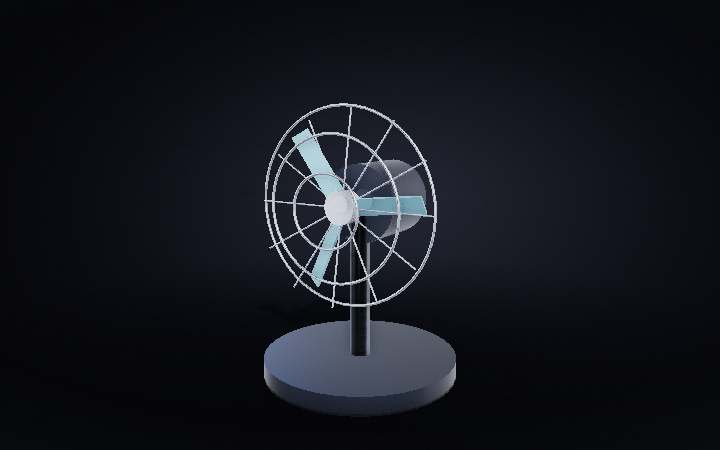
A desk fan is just four systems: a weighted base, an electric motor in the head, three pitched blades on the motor shaft, and a wire guard so you keep your fingers. The copper ring inside the housing is the stator — the electromagnet that does all the work.
Step 02 of 04
The motor spins
Alternating current in the stator coils creates a rotating magnetic field. The rotor chases that field, dragging the shaft — and the blades bolted to it — around with it, about 20 times every second.
Step 03 of 04
Blades push the air
Each blade is tilted like a boat propeller. As it sweeps around, its angled face shoves air backward-to-forward, carving a moving column of air out in front of the fan. More tilt or more speed means more breeze.
Step 04 of 04
The sweep
A small gearbox on the back of the motor turns the fast spin into a slow push-pull on a crank linked to the stand. That link swings the whole head left and right, sweeping the airflow across the room. Flip the knob and the crank disconnects — the fan stares straight ahead.