How a Treadmill Works
One motor, two rollers and a waxed board — how a machine that never moves an inch carries you 10 km, and why the belt stays dead centre.
Step 01 of 08
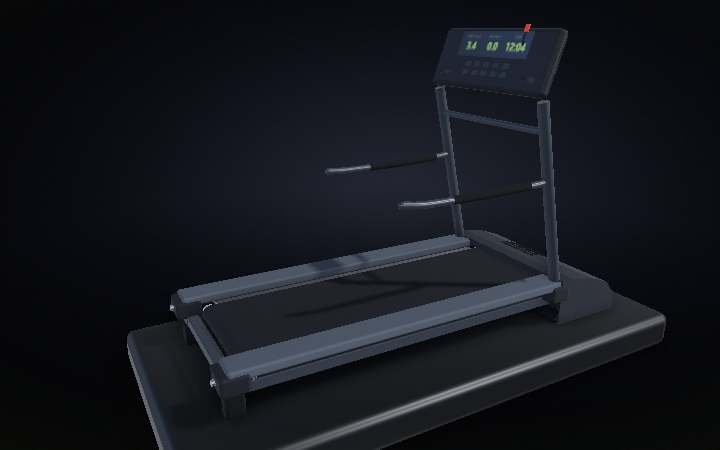
None of it takes you anywhere
You step on, press a plus sign, and a rubber loop starts pouring backwards under your feet. From the outside that is the whole machine: a black band, two rails to stand on when you want off, a handful of buttons, and a plastic hood at the front you have never once looked under. Everything that does the work is beneath that hood and beneath your feet — and the machine itself never moves an inch.
Step 02 of 08
One motor, two rollers, one loop
Lift the hood and the entire drivetrain is on the table. A DC motor about the size of a large jar, a ribbed belt running up from it, and a steel roller at each end of the deck with one continuous loop stretched around them. Only the front roller is driven. The rear one is a free-spinning idler that the belt drags round, and its only other job is to hold the loop tight. There is nothing else — no gearbox, no clutch, no second motor in the drive.
Step 03 of 08
Three motor turns for one of the roller’s
The motor spins fast and weak; the roller needs to turn slow and strong. So a small pulley on the motor shaft drives one three times its size on the roller — at a full sprint, around 4,000 rpm at the motor becomes 1,300 at the roller, with three times the torque. Bolted to the same shaft is a flywheel, a slab of steel whose only job is to keep turning through the split second your foot lands on the belt. And a magnet on the big pulley sweeps a hall sensor once per turn: the controller counts those pulses and trims the power thousands of times a second to hold your speed to a tenth of a km/h.
Step 04 of 08
It is not carrying you — it is sliding under you
The belt holds none of your weight. The board under it does. Every step presses the belt hard into a 19 mm sheet of phenolic-coated fibreboard, and the motor’s real work is dragging the belt across that board against friction. Which is why the top face is waxed: it drops the friction from around 0.6, a figure that would cook a motor in minutes, to under 0.1. Let the wax wear away and the motor pulls more current, runs hotter, and eventually stops. A dry board is the single most common way a treadmill dies.
Step 05 of 08
Eight rubber pucks between you and the floor
Watch the deck drop each time a foot lands. That board is not bolted to the frame — it floats on rubber elastomer pucks, and every footstrike squashes them a few millimetres before any of the load reaches the steel. Designers cap the deflection at about 8 mm; past that the belt starts to bunch. It is the whole reason a treadmill is kinder than pavement: concrete gives you nothing back, and this gives you a few millimetres of travel, every stride, a hundred and fifty times a minute.
Step 06 of 08
Why the belt never walks off the side
A flat loop on two flat rollers would wander sideways and chew itself against the frame within a mile. It doesn’t, because the drive roller is not a cylinder — it is very slightly barrel-shaped, a few tenths of a millimetre fatter in the middle, drawn much bigger here so you can see it. A belt always climbs toward the largest diameter it can find. Watch this one wander out across the 40 mm of spare roller face and get dragged back onto the crown on its own. When a belt still creeps, that is what the two bolts in the rear end caps are for: wind one end of the idler back further than the other and the belt follows it.
Step 07 of 08
The hill is a screw
Press incline and a second, far smaller motor turns a threaded steel rod. A nut walks down that thread, drives a leg into the floor, and the entire frame — deck, rollers, drive motor, console and you — tips up around the two rubber feet at the back. A quarter of a metre of screw travel is the whole range. Home machines stop near a 15% grade, and there is a good reason to stop: much past that and you are no longer running, you are climbing.
Step 08 of 08
Run it
Belt over the wax, roller under the pulley, flywheel eating every footstrike, magnet counting turns, controller trimming the power. And here is the one thing none of it can give you: air. Running indoors costs measurably less than running the same pace outside, because nothing is pushing back on you — so the standard correction is to set the incline to 1%. Above roughly a 10 km/h pace, that single number is what makes an hour on this machine honest.