How a UPI Payment Works
You scan, you tap, the shop's phone chimes — and no money moves. Nothing leaves your bank and nothing enters theirs: two banks edit their own private books because one machine in the middle told them to, sealed by a PIN the app you tapped is not allowed to read. The actual cash follows hours later, netted down, ten times a day.
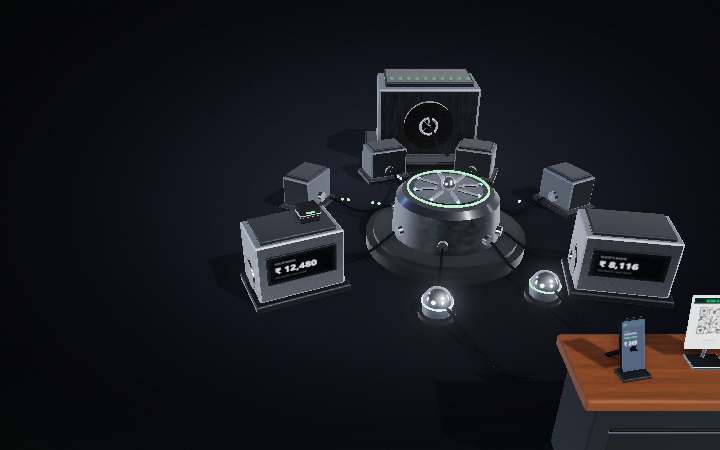
Step 01 of 08
1 · Two seconds at a counter
You hold your phone up to a printed square taped to the till, type ₹249, press your PIN, and somewhere behind the counter a phone says the money arrived. That is the entire experience, and India does it about 791 million times a day. Nothing here looks like a bank: no card, no terminal, no wire you can see. Just a sticker with an address on it.
Step 02 of 08
2 · One machine in the middle
Lift the counter away and the shape underneath is the whole trick. Your bank has no line to the shop's bank. Neither does any other bank. Every one of them — and every payment app, which is not a bank and borrows a sponsor bank's line to get here — runs a single cable to one switch operated by NPCI, and to nothing else. That is why an app you downloaded last night can pay into a bank it has never heard of: it doesn't have to know the bank at all, only the switch.
Step 03 of 08
3 · You pay a name, not an account
What the QR actually carries is an address like shop@okaxis — a stand-in the shop can print on a sticker without ever publishing its account number. The part after the @ is the routing instruction: it tells the switch which bank keeps the mapping from that address to a real account. The switch asks that one bank, and what comes back is the registered name — SHREE STORES. You get a name to check against the shopfront; the account number behind it never leaves the bank that holds it.
Step 04 of 08
4 · The PIN your app cannot read
Now the keypad appears — and it is not your app's keypad. It belongs to a piece of NPCI code called the Common Library, running on your own phone, and it seals what you type before the app around it can look. That sealed block travels through the app, through the sponsor bank, through the switch, and none of them can open it. It opens in exactly one place: tamper-resistant hardware inside your bank, which checks the PIN and destroys the block. This is why handing the keypad to a payment app is safe even though you would never hand it your password.
Step 05 of 08
5 · Subtract first, then add
With the PIN checked, the switch runs the payment in a strict order, and the order is the safety. First it tells your bank to debit: take ₹249 off this account, and tell me you did it. Only when that confirmation comes back does it tell the shop's bank to credit. Never both at once — because if the second half failed after both had fired, the money would exist twice or not at all. Each bank is writing in its own book, about its own customer, and neither can see the other's.
Step 06 of 08
6 · Nothing actually crossed
Here is what just happened, and what did not. One bank's book says ₹249 less. Another bank's book says ₹249 more. But the rupees that left the first were never the rupees that arrived at the second — there is no path between those two buildings for anything to travel along. Neither bank sent the other a single paisa. All the switch did was write down that one bank now owes the other, and both banks agreed to believe it. Your "instant transfer" is a promise, recorded.
Step 07 of 08
7 · Ten times a day, the real money moves
Those promises pile up in both directions all day, and most of them cancel. While your bank owes the shop's bank ₹249, a thousand payments are running the other way. So ten times a day the switch nets everything down — every debt in every direction collapsed into one figure per bank — and only that difference is actually settled, through accounts the banks hold at the Reserve Bank. Billions of rupees of payments, a handful of real transfers. The speed you felt was never the money moving. It was the message.
Step 08 of 08
8 · Nothing moved. Everybody agreed.
A sticker that is really an address. A PIN sealed on your own phone and opened nowhere else. One switch that every bank talks to and no bank talks around. Two books edited in a fixed order, a debt written down, and the actual cash following hours later, netted to almost nothing. That is what happens in the two seconds between your thumb and the chime — 24.5 billion times in a single month, over one machine in the middle.