How a V-Twin Engine Works
Two cylinders, one shared crankpin, and a 90° secret: why a V-twin balances itself perfectly — and why it thumps with that offbeat heartbeat.
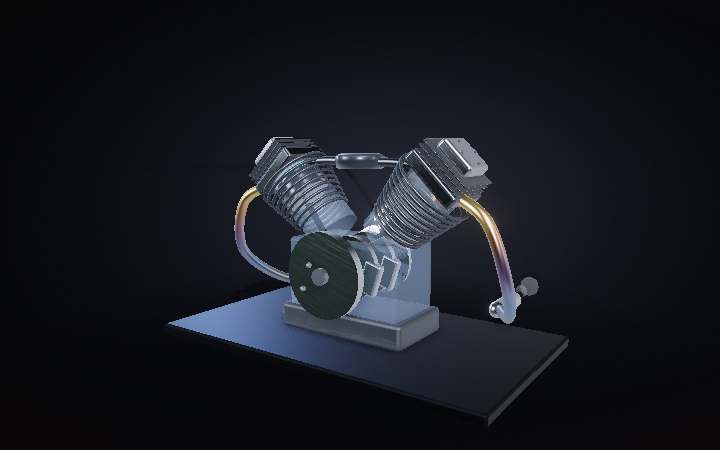
Step 01 of 06
The anatomy
Two air-cooled cylinders splayed 90° apart in a V, sharing one crankcase. Cylinder A leans right, cylinder B leans left, and down in the case both connecting rods grip the very same crankpin. One carburetor feeds both through the valley; each bank breathes out through its own swept exhaust header.
Step 02 of 06
1 · One pin, two rods
Here is the V-twin's defining trick: both con-rods ride the same crankpin, side by side. As the crank turns, the pin drags both rods around one shared circle — but because the cylinders point 90° apart, each piston reads that circle differently. When A is at the top of its bore, B is only halfway up its own.
Step 03 of 06
2 · Four strokes, two cylinders
Each cylinder runs the classic four-stroke recipe — intake (blue), compression, power (orange), exhaust (grey) — over two full crank turns. Watch both bores: they perform the same play, just never on the same line at the same time. The shared pin keeps them exactly 270° of crank apart.
Step 04 of 06
3 · The offbeat heartbeat
Count the sparks: bang, 270° later bang — then a long 450° pause before the next pair. A 90° V-twin cannot fire evenly, and that lopsided 270/450 rhythm is the exact sound you know from a big twin at idle: po-tato, po-tato. The flywheel carries the crank through the long silence.
Step 05 of 06
4 · The 90° secret
Why 90° and not 60 or 80? Balance. The crank's counterweight is sized to cancel one piston — which overcorrects, flinging its leftover force at right angles to the bore. With the second cylinder mounted exactly 90° around, that leftover lands squarely along ITS bore, cancelling that piston's shake too. One counterweight, two pistons, perfect primary balance — no balance shaft needed.
Step 06 of 06
Run it
Both cylinders working the shared pin, the offbeat pulses smoothed by the flywheel, the whole engine standing dead still while thousands of explosions a minute hammer through it. That is a V-twin: maximum character per cylinder.