How a Vacuum Cleaner Works
A vacuum never sucks. Its impeller throws air out of the machine, dropping the pressure inside by about a fifth of an atmosphere — and the outside air rushes in through the nozzle to fill the gap, dragging your carpet’s dirt with it.
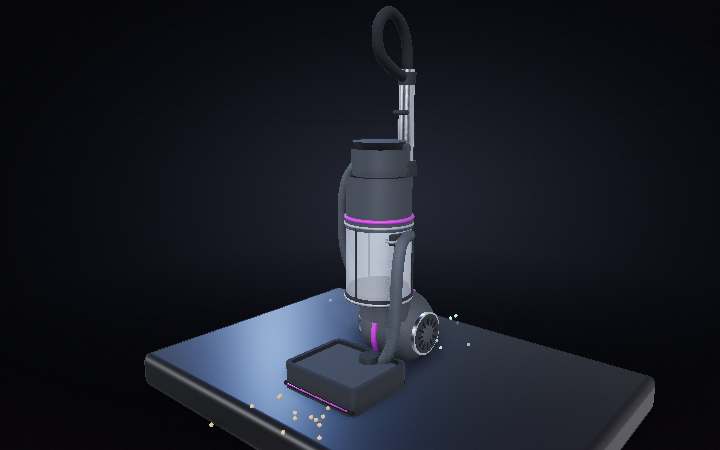
Step 01 of 07
1 · One long airway
From the outside an upright is a floor head, a clear bin at knee height and a handle to push. Run it forward and grit disappears off the carpet — a moment later it is sitting in that bin, dry and loose. Between those two moments nothing solid carries it. It rides on air.
Step 02 of 07
2 · The whole path, end to end
Ghost the shell and there is one continuous route: a slot in the floor plate, a duct running up the front, a spiral through the bin, a pleated filter, and a motor buried in the ball. Air makes that entire trip in a fraction of a second, and does it fifty to a hundred cubic feet at a time, every minute.
Step 03 of 07
3 · The head beats the carpet
Carpet will not give up dirt to airflow alone — grit sinks between the fibres and wedges there. So a brush roll spinning at one to three thousand rpm, driven off that small belt, hammers the pile from above. The shock shakes the grit loose for exactly as long as the air needs to take it. On hard floors you switch the roll off, because the same beating just flings grit sideways.
Step 04 of 07
4 · The bin spins the dirt out
The duct does not aim at the bin. It aims along its wall, so the air arrives already turning and keeps turning. Dust is hundreds of times denser than air and cannot make the tight inward corner: it slides out, hits the wall, loses its speed and drops. What is left turns in through the shroud — the fine mesh column in the middle — and heads up. Nothing is straining through a bag, which is why the suction does not fade as the bin fills.
Step 05 of 07
5 · Seven small cones for the fine stuff
Big debris is the easy half. Talc, pollen and skin flakes are light enough to follow the air around a slow corner, so the flow is split into seven narrow cones and the same trick is run much harder: the air accelerates from about 45 to 120 mph, and the spin puts over 79,000 g on everything in it. At that force even a grain of pollen is thrown to the wall. It slides to the tip and drops through the plate into the bin below. Whatever still survives meets the pleated pre-motor filter above.
Step 06 of 07
6 · The motor never actually sucks
This is the part that surprises people: nothing in a vacuum pulls. An impeller inside the ball spins and throws air out through the vents in its sides, leaving the inside of the machine at roughly four fifths of normal air pressure. The atmosphere in your room is what does the pushing — it shoves air, and everything loose in it, down that slot to fill the gap. The exhaust leaves through a HEPA filter that keeps 99.97% of what is left, down to 0.3 micron.
Step 07 of 07
7 · Air doing all of the work
Sealed back up it is a brush, a bent tube, a spinning bin and a fan. The brush loosens, the fan lowers the pressure, the room pushes, and the corner does the sorting — and the only thing that ever carries your dirt is moving air, from the second it leaves the carpet to the second it lands in the bin.