How a Washing Machine Works
Two drums, a concrete block and a motor with no belt — how a front loader lifts your clothes, drops them, and then spins them at 500 times gravity.
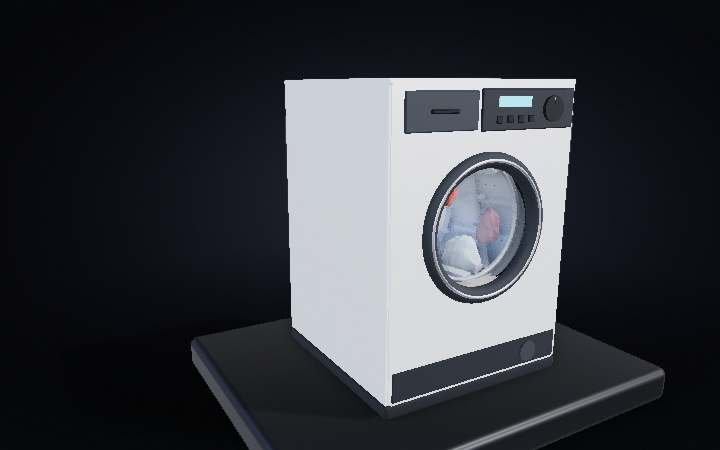
How does a washing machine work?
A front-loading washing machine fills the sump with just enough water to wet the load, heats it with an internal element, tumbles the clothes gently by lifting and dropping them through the water, then drains and spins the drum at up to 1,400 RPM to fling the remaining water off by force alone. Nothing squeezes the fabric — the water is simply thrown outward, at roughly 500 times the pull of gravity.
Step 01 of 07
The one machine you shut and walk away from
A washing machine asks for a door slam and a dial, and then tells you nothing for two hours. Behind the glass a drum turns over. Behind the drum sits everything else — a water valve, a heater, a pump, a motor, and a slab of concrete — and none of it is visible from the outside. The white box is doing chemistry, plumbing and 500 g of centrifuge, all under a lid you cannot open while it runs.
Step 02 of 07
Two drums, and only one of them turns
Take the cabinet off and the machine is a drum inside a drum. The outer tub is a sealed plastic bucket that holds the water and never moves. The perforated stainless drum inside it is the only part that spins. And the whole assembly is hanging, not bolted: two springs carry it from the top corners, two friction dampers push back from the base, and about 25 kg of concrete is bolted on to give it the mass to fight its own vibration.
Step 03 of 07
It fills through the soap, then heats its own water
A solenoid valve at the back opens, and mains water takes the long way in: up over the top, down through the detergent drawer, washing the powder along with it into the tub. What collects in the sump is cold, so a sheathed 2 kW element down there boils it up to the programme temperature. The machine never sees the water level — a thin hose traps a column of air under the tub, rising water squeezes it, and a pressure sensor reads that squeeze as centimetres.
Step 04 of 07
Lift, drop, repeat
Three ridges run down the inside of the drum. They catch the load, carry it up the wall, and hand it to gravity: the clothes fall back through the water and slap into the bottom, flexing the weave so detergent floods in and out of every fibre. That only works slowly. Past about 60 rpm the wall is pulling the load outward harder than gravity pulls it down, nothing falls, and the machine is just turning a heavy tube — so wash tumbling sits near 50.
Step 05 of 07
The motor is the back of the drum
Older machines drive the drum with a belt and a big pulley. This one has neither. The drum shaft passes through a bearing in the tub wall and bolts straight to the rotor — a steel pot carrying 36 permanent magnets, cut away here so you can see what it sits over: a stator of wound copper coils. The controller energises those coils in a rotating pattern and the magnets chase it, so the drum turns at exactly the speed the electronics ask for. One motor, no gearing — which is how the same machine holds a lazy 50 rpm tumble and a 1400 rpm spin.
Step 06 of 07
Spin: five hundred times gravity
The pump empties the tub first — nothing accelerates with a bath still in it. Then the drum ramps up, and at 1400 rpm the wall is throwing your clothes outward at roughly 500 times gravity. Water has nowhere to go but through the perforations, down the outer tub and back to the pump. Nothing is wrung or squeezed; the water is simply flung off the fabric. An out-of-balance load at that speed would walk the machine across the floor, which is what the concrete, the springs and the dampers are quietly absorbing.
Step 07 of 07
Run it
Fill through the soap, heat it in the sump, tumble at 50 so gravity can do the scrubbing, drain, then throw the water off at 1400. Two drums, one belt-less motor, and a block of concrete holding the whole thing still while it happens.
The parts
- Outer tub — The sealed plastic bucket that holds the water. It never moves — it just contains whatever the inner drum is doing.
- Inner drum — The perforated stainless drum inside the tub, and the only part that actually spins. Its perforations are the only way water can leave during a spin.
- Lifter paddle — Ridges running down the inside of the drum that catch the load, carry it up the wall, and let gravity drop it back through the water — that lift-and-drop is the entire washing action.
- Heating element — A sheathed element, roughly 2 kW, sitting in the sump. The machine fills with cold mains water and heats it itself rather than relying on a hot supply.
- Drain pump — Empties the tub before the spin cycle starts, and again at the very end — spinning up a drum with a bath still in it would waste most of the motor’s effort fighting water instead of flinging it.
- Counterweight and suspension — Roughly 25 kg of concrete bolted to the frame, hung on springs with friction dampers pushing back from the base — together they absorb the shake of a fast-spinning, occasionally uneven load instead of letting it walk the machine across the floor.
- Direct-drive motor — A rotor carrying dozens of permanent magnets bolts straight onto the drum shaft — no belt, no pulley. A stator of wound copper coils chases the magnets electronically, which is how the same motor holds both a lazy 50 RPM tumble and a 1,400 RPM spin.
- Door bellows — The flexible rubber seal that keeps water inside a front-loader while still letting the door open. Its folds are also exactly where mold tends to grow if the machine is closed up wet between washes.
Numbers that matter
| Figure | Value | Note |
|---|---|---|
| Spin speed | up to 1,400 RPM | reached only after the tub has fully drained |
| Force at the drum wall (spin) | ~500 × gravity | why water is flung off fabric instead of needing to be wrung out |
| Counterweight mass | ~25 kg | concrete, bolted to the frame specifically to resist vibration |
| Heating element power | ~2 kW | heats cold mains water in the sump rather than relying on a hot feed |
| Water used per wash | ~50 L | clothes are wetted, not floated — a fraction of what a full-submersion machine needs |
| Wash tumble speed | ~50 RPM | deliberately kept below the point where the load stops falling at all |
| Rotor magnet count | 36 | the ring of permanent magnets the stator coils chase to turn the drum |
Common questions
Why do front loaders use so much less water than top loaders?
A front loader tumbles clothes through a shallow pool using gravity, rather than fully submerging them — typically 10 to 15 gallons a load against 30 to 40 for a conventional top loader. It cleans by lifting and dropping the load through the water repeatedly, not by floating it, so it never needs to fill the drum.
Why does my washing machine smell musty?
The same tight rubber door seal that stops a front loader leaking also traps moisture against detergent and fabric-softener residue — exactly the damp, organic film mold needs. Leaving the door open between washes and wiping the gasket down after use are the two habits that matter most.
How does the machine know when a load is out of balance?
Most modern direct-drive machines don’t need a separate sensor for it — the motor controller watches its own current and speed as the drum turns, and an uneven load makes that pattern uneven too. Detecting that, the machine will often pause to redistribute the load before ramping the spin back up, rather than letting an imbalance grow at speed.
Why does the drum only tumble at about 50 RPM instead of running fast the whole cycle?
Past roughly 60 RPM, the drum wall is pulling the load outward harder than gravity pulls it down — nothing falls anymore, and the machine is just spinning a heavy tube with no scrubbing action at all. Wash tumbling stays well under that threshold on purpose.
Is a washing machine really spinning clothes at 500 times gravity?
At the drum wall during a 1,400 RPM spin, yes — that’s the outward force anything loose has to resist to stay attached. Water can’t resist it, which is exactly the point: it’s flung straight through the drum’s perforations instead of needing to be wrung out.
What goes wrong
Why won’t my washing machine drain?
Almost always a blocked drain pump filter or impeller — coins, zipper tabs, or small stones that made it through a pocket and got caught. Signs include water pooling at the bottom of the drum, slow drainage during the cycle, and a humming noise as the pump struggles against the obstruction.
What does a grinding or screeching noise during spin usually mean?
Worn bearings, most often. A steady grinding or humming during draining points to the pump; a high-pitched screech or whine more often points to worn motor or pump bearings; a rattle specifically during draining usually means debris trapped in the pump impeller rather than bearing wear.
What stops an out-of-balance load from shaking the machine apart?
Several layers at once: the counterweight and suspension absorb ordinary imbalance by design, but if the controller detects an imbalance it can’t safely spin through, it stops the ramp-up entirely rather than letting the shake build — which is why a badly unbalanced load sometimes ends a cycle without ever reaching full spin speed.